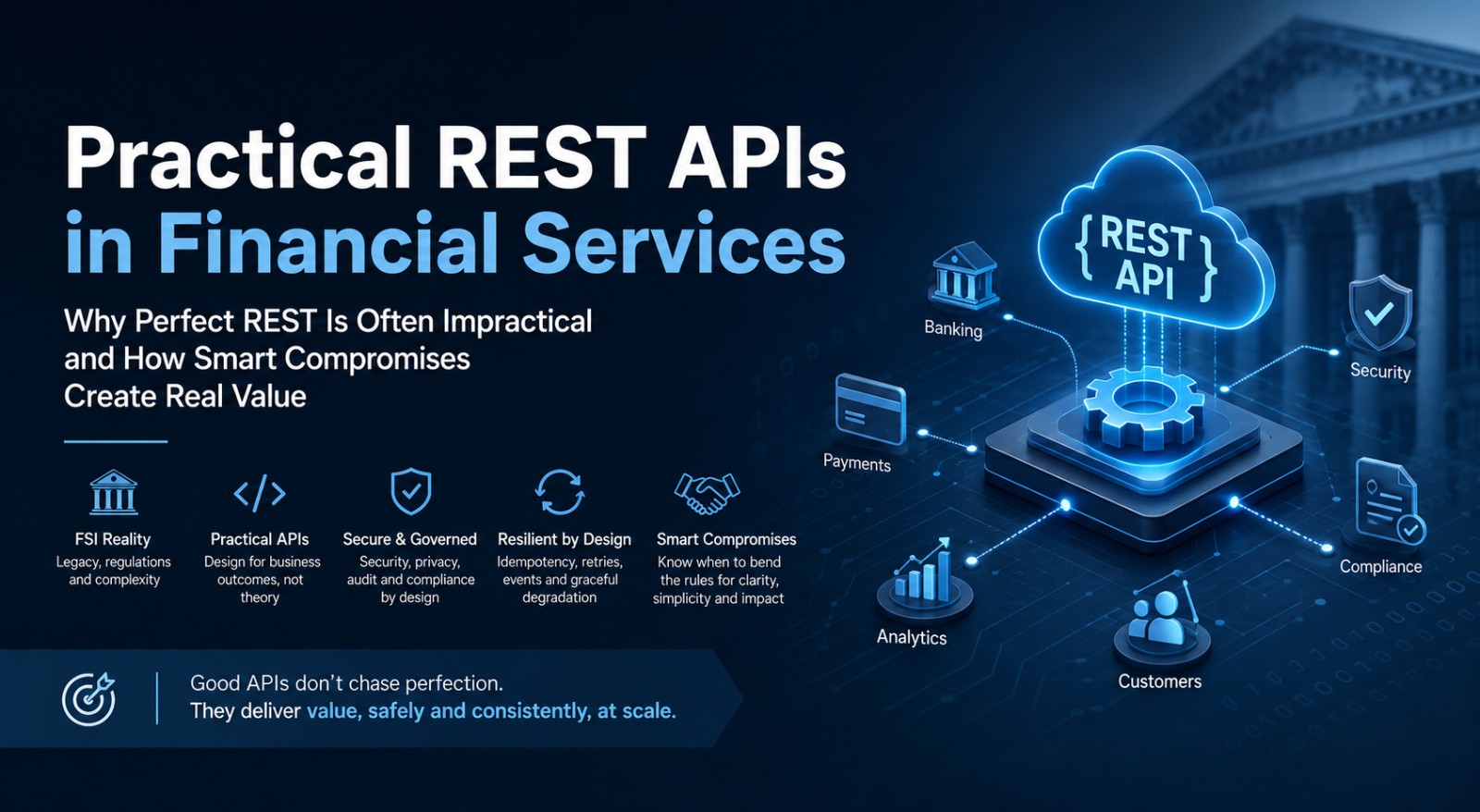
Practical REST APIs in Financial Services: Why Perfect REST Is Often Impractical
REST is one of those topics where architectural discussions can become surprisingly ideological.
We debate resource purity.
We debate whether verbs belong in URLs.
We debate PUT versus PATCH.
We debate whether everything must be modeled as a noun.
We debate the correct status code for every edge case.
And in theory, these discussions are useful.
In a financial-services enterprise, however, API design is rarely an academic exercise.
It has to coexist with:
- legacy core systems,
- mainframes,
- policy administration platforms,
- payment engines,
- claims systems,
- partner integrations,
- batch processing,
- regulatory controls,
- fraud checks,
- audit requirements,
- idempotency requirements,
- long-running workflows,
- asynchronous processing,
- strict authorization boundaries,
- operational recovery,
- and systems built across multiple decades.
That changes the problem.
The goal is not to build the most theoretically perfect REST API.
The goal is to build an API that is:
- understandable,
- consistent,
- secure,
- governable,
- reliable,
- operable,
- evolvable,
- and practical enough to work across the enterprise.
Perfect REST is a useful design direction.
It is not always a practical destination.
REST Purity Versus Enterprise Reality
A clean REST model starts with resources.
For example:
GET /customers/123
GET /policies/456
GET /claims/789
Resources are manipulated through standard HTTP semantics.
POST
GET
PUT
PATCH
DELETE
This is elegant.
But financial-services workflows are often not simple CRUD.
Consider a life-insurance claim.
A claim may need to be:
- submitted,
- validated,
- assigned,
- investigated,
- suspended,
- reopened,
- approved,
- rejected,
- escalated,
- settled,
- partially paid,
- referred for fraud review,
- or returned for additional documents.
Trying to force all of this into pure CRUD can actually make the API harder to understand.
flowchart LR
    A["REST Theory"] --> B["Resources"]
    B --> C["CRUD Semantics"]

    D["FSI Reality"] --> E["Stateful Business Processes"]
    E --> F["Approvals"]
    E --> G["Long-running Workflows"]
    E --> H["Regulatory Controls"]
    E --> I["Legacy Integration"]
    E --> J["Async Processing"]

    C --> K["Practical API Design"]
    F --> K
    G --> K
    H --> K
    I --> K
    J --> K
The practical API sits between architectural principles and business reality.
What REST Gives Us That Is Still Valuable
Saying that perfect REST is impractical does not mean REST principles are irrelevant.
Quite the opposite.
REST gives us valuable constraints that make APIs easier to understand.
A good enterprise API should still aim for:
- resource-oriented URLs,
- consistent HTTP methods,
- standard status codes,
- stateless interactions where possible,
- predictable representations,
- clear versioning rules,
- cache semantics where applicable,
- stable identifiers,
- idempotent operations where appropriate,
- and separation between transport and business logic.
The mistake is treating these principles as absolute laws.
Good architecture uses principles to reduce complexity.
Bad architecture uses principles to deny complexity exists.
1. Start With Resources, Not Backend Systems
One of the most common enterprise API mistakes is exposing backend implementation directly.
For example:
POST /executeClaimTransaction
POST /runPolicyUpdate
GET /fetchCustomerRecord
These are effectively RPC operations over HTTP.
Sometimes that is unavoidable internally.
But it should not be the default enterprise contract.
A consumer should not need to understand the structure of the backend implementation.
A better model is:
GET /customers/{customerId}
GET /policies/{policyId}
GET /claims/{claimId}
POST /claims
PATCH /claims/{claimId}
The API contract should represent the business domain.
Not the internal application.
This matters especially in FSI because backend systems change slowly and inconsistently.
A stable API layer protects consumers from those changes.
flowchart LR
    A["Channel / Consumer"] --> B["Enterprise API"]
    B --> C["Domain Model"]

    C --> D["Core Insurance System"]
    C --> E["Claims Platform"]
    C --> F["Customer System"]
    C --> G["Document Platform"]
    C --> H["Mainframe"]

    B -. "Stable Contract" .-> A
    C -. "Backend Abstraction" .-> D
The API should hide system boundaries wherever possible.
2. Do Not Turn REST Into Religion
A common anti-pattern is refusing to represent business actions because "REST must only have nouns."
Suppose a claim must be approved.
A strict interpretation may produce something like:
PATCH /claims/123
{
  "status": "APPROVED"
}
This looks RESTful.
But it may be semantically dangerous.
Approval is usually not just a field update.
It may trigger:
- authorization checks,
- segregation-of-duty validation,
- payment calculations,
- compliance checks,
- notifications,
- accounting entries,
- downstream events,
- audit records.
Treating approval as a generic status update hides important business semantics.
A more practical endpoint may be:
POST /claims/123/approval
or:
POST /claims/123/actions/approve
Some REST purists will object.
But the endpoint communicates intent clearly.
That is often more valuable than theoretical purity.
3. Business Commands Are Sometimes Better Than Fake CRUD
There is a useful distinction between resource manipulation and business commands.
For example:
PATCH /customers/123
is different from:
POST /claims/123/actions/reopen
If an operation represents a meaningful domain action with validation, permissions, workflow transitions, side effects, audit consequences, and clear business meaning, then modeling it explicitly can improve the API.
Examples in financial services include:
POST /payments/{id}/cancel
POST /claims/{id}/reopen
POST /policies/{id}/reinstate
POST /accounts/{id}/freeze
POST /applications/{id}/submit
POST /underwriting-cases/{id}/refer
These are not perfectly pure REST.
They are often good enterprise APIs.
The rule should be:
Use command-style endpoints intentionally, not lazily.
Do not make everything an action.
Use actions where the domain truly contains commands.
4. HTTP Methods Should Reflect Intent
A practical baseline is:
| Method | Use |
|---|---|
GET |
Retrieve state |
POST |
Create a resource or execute a non-idempotent command |
PUT |
Replace a full resource or perform a known idempotent write |
PATCH |
Partially modify a resource |
DELETE |
Remove a resource when deletion is truly supported |
One common mistake is using POST for everything.
Another is forcing PUT or PATCH when the operation is really a business command.
The question should be:
What does the operation mean to the consumer?
not:
Which method makes the architecture diagram look most RESTful?
5. Financial APIs Need Idempotency by Design
In financial systems, duplicate execution can be catastrophic.
A consumer may send:
POST /payments
The request succeeds.
But the network connection drops before the response reaches the client.
The client retries.
Without protection, two payments may be created.
This is why idempotency must be a first-class design concern.
A common pattern is:
POST /payments
Idempotency-Key: 7d91a123-...
The server stores the execution result against the key.
If the same request is retried, the original result is returned rather than creating another transaction.
sequenceDiagram
    participant Client
    participant API
    participant IdempotencyStore
    participant PaymentService

    Client->>API: POST /payments + Idempotency-Key
    API->>IdempotencyStore: Check key
    IdempotencyStore-->>API: Not found
    API->>PaymentService: Create payment
    PaymentService-->>API: Payment created
    API->>IdempotencyStore: Store result
    API-->>Client: 201 Created

    Note over Client,API: Network failure occurs

    Client->>API: Retry same request
    API->>IdempotencyStore: Check key
    IdempotencyStore-->>API: Existing result
    API-->>Client: Return original response
This is much more important in FSI than debating whether a URL contains a perfect noun.
6. Idempotency Is Not Just for Payments
The same issue exists for:
- claim submission,
- policy issuance,
- benefit payout,
- account transfer,
- identity-verification initiation,
- document submission,
- customer onboarding,
- loan application creation,
- and any business operation with expensive side effects.
You should define:
- idempotency-key format,
- uniqueness scope,
- retention duration,
- retry semantics,
- response replay behavior,
- conflict behavior,
- and logging requirements.
Without a common standard, every team invents a different approach.
7. Long-Running FSI Processes Should Not Pretend to Be Synchronous
Many enterprise operations do not complete in milliseconds.
Consider:
POST /claims/123/assessment
The process may involve:
- document extraction,
- fraud checks,
- medical review,
- policy validation,
- external services,
- human review.
Keeping the HTTP request open is usually the wrong design.
A better response may be:
202 Accepted
Location: /operations/abc123
Then:
GET /operations/abc123
Response:
{
  "operationId": "abc123",
  "status": "IN_PROGRESS",
  "progress": 60
}
Eventually:
{
  "operationId": "abc123",
  "status": "COMPLETED",
  "result": {
    "claimId": "123"
  }
}
sequenceDiagram
    participant Consumer
    participant API
    participant Workflow
    participant ExternalSystems

    Consumer->>API: POST /claims/123/assessment
    API->>Workflow: Start workflow
    API-->>Consumer: 202 Accepted + operationId

    Workflow->>ExternalSystems: Checks / validations
    ExternalSystems-->>Workflow: Results

    Consumer->>API: GET /operations/abc123
    API-->>Consumer: IN_PROGRESS

    Workflow->>Workflow: Complete processing

    Consumer->>API: GET /operations/abc123
    API-->>Consumer: COMPLETED
For some workflows, webhook or event notification can reduce polling.
8. REST and Events Should Work Together
A frequent architecture mistake is assuming every integration must be REST.
REST is strong for:
- request/response,
- queries,
- commands,
- immediate validation,
- resource manipulation.
Events are strong for:
- notification,
- loose coupling,
- fan-out,
- asynchronous workflows,
- audit trails,
- eventual consistency.
Financial services often need both.
flowchart LR
    A["Consumer"] -->|"REST Command"| B["Claims API"]
    B --> C["Claims Domain"]
    C -->|"Domain Event"| D["Event Bus"]

    D --> E["Fraud Service"]
    D --> F["Notification Service"]
    D --> G["Analytics"]
    D --> H["Document Workflow"]
    D --> I["Audit / Monitoring"]
Trying to solve everything with REST often creates tightly coupled chains of synchronous calls.
Trying to solve everything with events makes simple interactions unnecessarily complex.
Practical architecture uses the right interaction model for the right problem.
9. Avoid Distributed Monoliths
An API can be RESTful and still create terrible architecture.
Consider:
Channel
  -> Customer API
      -> Policy API
          -> Billing API
              -> Customer API
                  -> Identity API
Every request depends on a chain of synchronous services.
One downstream issue can cause cascading failures.
This architecture is technically service-oriented but operationally behaves like a distributed monolith.
flowchart LR
    A["Client"] --> B["API A"]
    B --> C["API B"]
    C --> D["API C"]
    D --> E["API D"]
    E --> F["Legacy System"]

    F -. "Failure" .-> E
    E -. "Failure" .-> D
    D -. "Failure" .-> C
    C -. "Failure" .-> B
    B -. "Failure" .-> A
Better approaches may include:
- local domain ownership,
- controlled aggregation,
- caching,
- events,
- materialized views,
- asynchronous workflows,
- circuit breakers,
- and reducing unnecessary service boundaries.
10. Do Not Expose Your Database Model as Your API
Another common mistake is designing APIs directly from relational tables.
For example:
GET /customer_table
GET /policy_master
GET /claim_header
GET /claim_detail
This leaks implementation.
It also creates brittle consumer dependencies.
Instead, define APIs around domain concepts.
GET /customers/{id}
GET /policies/{id}
GET /claims/{id}
Internally, those may aggregate data from many tables or systems.
That is the API layer's job.
11. Pagination Is Not Optional
Enterprise APIs can quickly return very large datasets.
Never assume:
GET /claims
will always return a manageable amount of data.
Use pagination.
Common options include:
GET /claims?limit=100&offset=200
or cursor-based pagination:
GET /claims?limit=100&cursor=eyJpZCI6...
For high-volume or frequently changing data, cursor-based pagination is often more reliable.
A standard response might be:
{
  "items": [],
  "pagination": {
    "nextCursor": "abc123",
    "hasMore": true
  }
}
Pagination should be part of the enterprise API standard, not something each team invents.
12. Filtering and Sorting Need Governance
It is tempting to allow arbitrary filters:
GET /claims?field=x&operator=y&value=z
This can eventually become impossible to optimize, difficult to secure, inconsistent, and tightly coupled to persistence models.
Prefer controlled filters:
GET /claims?status=OPEN&customerId=123&createdAfter=2026-01-01
For complex search scenarios, a dedicated search resource may be clearer:
POST /claims/search
Yes, using POST for search is not pure REST.
But it can be justified when the search criteria are large, structured, security-sensitive, or too complex for query strings.
Again: practical clarity over ideology.
13. Status Codes Should Be Consistent, Not Clever
Enterprises do not need every developer to become a scholar of obscure HTTP codes.
A concise standard is usually better.
| Status | Meaning |
|---|---|
200 |
Successful read/update |
201 |
Resource created |
202 |
Accepted for async processing |
204 |
Successful with no response body |
400 |
Invalid request |
401 |
Authentication required or failed |
403 |
Authenticated but not authorized |
404 |
Resource not found |
409 |
Conflict or business-state conflict |
422 |
Business validation failure |
429 |
Rate limit exceeded |
500 |
Unexpected server error |
503 |
Temporary service unavailable |
The exact policy matters less than consistent enterprise behavior.
14. Separate Technical Errors From Business Errors
This is especially important in FSI.
A request may be technically valid but fail a business rule.
For example:
POST /claims/123/actions/approve
The caller is authenticated.
The JSON is valid.
But approval is impossible because required documents are missing.
That is not necessarily a 500.
A structured error model may look like:
{
  "error": {
    "code": "CLAIM_DOCUMENTS_INCOMPLETE",
    "message": "The claim cannot be approved until required documents are received.",
    "correlationId": "a312...",
    "details": [
      {
        "field": "documents",
        "reason": "death_certificate_missing"
      }
    ]
  }
}
Good APIs make failures predictable.
15. Never Make Consumers Parse Error Messages
Do not make client systems depend on strings like:
Customer not eligible
Instead provide a stable code:
{
  "code": "CUSTOMER_NOT_ELIGIBLE"
}
Messages can change.
Error codes become contracts.
In multinational financial institutions, this is even more important because messages may be localized while machine-readable codes remain stable.
16. Correlation IDs Are Essential
When a transaction crosses API gateways, microservices, mainframes, event brokers, databases, and external providers, support teams need a way to trace it.
Every request should carry or receive a correlation identifier.
For example:
X-Correlation-ID: 854fe8...
That identifier should appear in:
- logs,
- distributed traces,
- audit records,
- downstream calls,
- operational dashboards.
In a regulated production environment, observability is part of API design.
Not an afterthought.
17. Security Must Be Part of the Contract
FSI APIs must assume that authorization is domain-specific.
Authentication tells you:
Who is the caller?
Authorization answers:
Is this caller allowed to perform this specific operation on this specific resource?
For example, a claims agent may be allowed to view a claim but not approve it.
A supervisor may approve claims below a defined amount.
High-value claims may require additional review.
That means authorization may depend on:
- role,
- geography,
- department,
- product,
- claim value,
- policy ownership,
- customer relationship,
- workflow state.
This is more sophisticated than simply checking a JWT role.
flowchart LR
    A["API Request"] --> B["Authenticate"]
    B --> C["Identity / Claims"]
    C --> D["Policy Decision"]

    D --> E["Role"]
    D --> F["Resource"]
    D --> G["Transaction Value"]
    D --> H["Workflow State"]
    D --> I["Risk Context"]

    D --> J{"Allow?"}
    J -->|"Yes"| K["Execute"]
    J -->|"No"| L["403 Forbidden"]
18. Data Minimization Matters
Do not return everything simply because it exists.
A customer record may contain:
- name,
- address,
- phone,
- medical information,
- bank details,
- policy history,
- beneficiary data,
- tax identifiers.
Different consumers need different views.
An API should avoid exposing unnecessary sensitive information.
This reduces privacy risk, accidental logging, downstream data proliferation, and breach impact.
In financial services, API design and data-governance design are tightly connected.
19. Versioning Is a Governance Problem
There are endless debates about versioning.
Examples:
/v1/customers
versus header-based versioning.
Either can work.
The bigger problem is uncontrolled breaking change.
An enterprise standard should define:
- what constitutes a breaking change,
- what changes are backward-compatible,
- deprecation periods,
- consumer notification,
- migration expectations,
- support windows,
- and retirement procedures.
Adding an optional field usually should not require a new version.
Renaming an existing mandatory field probably does.
Versioning policy matters more than versioning syntax.
20. Avoid Version Explosion
Poor governance creates:
v1
v1.1
v1.2
v2
v2.1
v3beta
v4
with nobody knowing which consumers use what.
Versioning should be deliberate.
Backward-compatible evolution should be the default.
Breaking versions should be relatively rare.
21. Contract-First Design Pays Off
For large enterprises, an API should exist as a contract before implementation.
OpenAPI can define endpoints, payloads, status codes, schemas, examples, and security requirements.
This enables:
- architecture review,
- consumer feedback,
- mock servers,
- automated tests,
- documentation,
- policy checks,
- SDK generation.
flowchart LR
    A["Domain Design"] --> B["OpenAPI Contract"]
    B --> C["Consumer Review"]
    B --> D["Mock API"]
    B --> E["Security Review"]
    B --> F["Automated Rules"]

    C --> G["Implementation"]
    D --> G
    E --> G
    F --> G

    G --> H["Contract Tests"]
    H --> I["Deployment"]
Contract-first design is particularly valuable when multiple teams or vendors are involved.
22. API Governance Should Automate the Boring Parts
An architecture board should not manually inspect every API for naming, pagination, status codes, security declarations, schemas, and descriptions.
Many of these checks can be automated.
OpenAPI
   ↓
Linting
   ↓
Security policy checks
   ↓
Naming checks
   ↓
Breaking-change detection
   ↓
Contract tests
   ↓
Publish
Human governance should focus on domain boundaries, high-risk designs, business semantics, exceptions, and architectural trade-offs.
Machines should enforce repeatable rules.
23. Not Every Internal API Needs the Same Standard
This is another place where enterprises over-engineer.
A public or partner API may need long-term compatibility, formal versioning, stricter documentation, throttling, developer onboarding, and consent models.
A private internal API between two tightly coupled services may not need the same overhead.
You can classify APIs.
flowchart TD
    A["API"] --> B{"Exposure"}

    B --> C["Public"]
    B --> D["Partner"]
    B --> E["Enterprise Internal"]
    B --> F["Service Internal"]

    C --> G["Highest Governance"]
    D --> H["Strong Governance"]
    E --> I["Standard Governance"]
    F --> J["Lightweight Governance"]
Governance should be proportional to impact.
24. Never Let a Temporary API Become Permanent Without Review
FSI environments often create emergency or transitional APIs.
For example:
“We need this endpoint temporarily until the new policy system launches.”
Five years later it is processing millions of calls.
Temporary interfaces need:
- ownership,
- expiration date,
- observability,
- review milestones,
- migration plan.
Otherwise technical debt quietly becomes critical infrastructure.
25. Composite APIs Can Be Useful
Pure service separation may force consumers to make many calls.
For example, a customer portal needs profile, policies, claims, and payment summary.
Making the browser call four or ten backend APIs may be inefficient.
A consumer-oriented or experience API can aggregate them.
flowchart LR
    A["Mobile / Web"] --> B["Experience API"]

    B --> C["Customer API"]
    B --> D["Policy API"]
    B --> E["Claims API"]
    B --> F["Payments API"]
This is not a violation of good architecture.
It is often a useful separation between system APIs, domain APIs, process APIs, and experience APIs.
The important thing is avoiding duplication of core business logic.
26. Rate Limiting Is Also a Resilience Control
Rate limits are not only for public APIs.
Internal systems can accidentally overload each other.
A malformed batch or retry storm can generate enormous traffic.
Use:
- per-client quotas,
- rate limits,
- concurrency controls,
- circuit breakers,
- retry policies,
- backoff,
- bulkheads.
Financial-services resilience engineering should assume dependencies will fail.
27. Retries Can Make Outages Worse
"Retry on failure" sounds sensible.
But thousands of clients immediately retrying can overwhelm a recovering system.
Use exponential backoff.
For example:
1 second
2 seconds
4 seconds
8 seconds
+ jitter
Never blindly retry non-idempotent operations.
This is why retries and idempotency must be designed together.
28. Avoid Chatty APIs Across High-Latency Boundaries
A design that works in one data center may perform badly when calling another cloud region, another country, an on-premises mainframe, or a SaaS provider.
Instead of 20 small API calls, sometimes one coarse-grained API is more practical.
This is another example where theoretical purity can harm system performance.
API granularity should consider network boundaries.
29. Legacy Systems Will Force Compromise
A mainframe may only support fixed-format messages, batch updates, stored procedures, MQ, or proprietary protocols.
The REST layer may need to adapt modern semantics to legacy behavior.
That is acceptable.
What matters is preventing legacy constraints from leaking through the enterprise contract unnecessarily.
flowchart LR
    A["Consumer"] --> B["REST API"]
    B --> C["Domain Service"]
    C --> D["Anti-Corruption Layer"]
    D --> E["Legacy Mainframe"]

    D -. "Translate" .-> F["Legacy Messages"]
The anti-corruption layer protects the modern domain model from legacy implementation details.
30. Perfect Consistency Is Often Impossible
Financial systems frequently span multiple systems of record.
A transaction may update customer data, payment state, policy status, accounting, and documents.
A distributed ACID transaction across all systems may be impossible or undesirable.
You may need eventual consistency.
Patterns include:
- saga,
- outbox,
- compensation,
- reconciliation,
- event-driven updates.
flowchart LR
    A["Business Transaction"] --> B["Service A"]
    B --> C["Persist State"]
    C --> D["Outbox Event"]
    D --> E["Event Bus"]
    E --> F["Service B"]
    E --> G["Service C"]

    F --> H["Eventually Consistent"]
    G --> H
The compromise is acceptable if it is explicit, observable, and recoverable.
31. Reconciliation Is a Feature, Not a Failure
In financial services, systems can disagree.
Messages can be delayed.
External providers can fail.
Batch processes can partially complete.
A mature architecture includes reconciliation.
For example:
Compare policy payment status in the payment platform against the policy administration system and identify mismatches.
Do not assume distributed systems will remain perfectly synchronized forever.
Design mechanisms to detect and repair inconsistency.
32. Auditability Is Different From Logging
Application logs are usually optimized for diagnostics.
Audit records are optimized for accountability.
An audit trail may need:
- who performed an action,
- what changed,
- old value,
- new value,
- timestamp,
- channel,
- delegated identity,
- approval context,
- correlation ID.
Do not assume general application logs satisfy audit requirements.
33. API Design Should Include Operational Questions
Before approving an API, ask:
- How do we trace requests?
- How do we throttle it?
- What is the timeout?
- What happens when dependencies fail?
- Can it be retried?
- Is it idempotent?
- How do we reconcile partial failures?
- What are the SLOs?
- Who owns production support?
- How do we know which consumers are affected by a breaking change?
These are architecture questions.
Not just operations questions.
34. The Worst API Is Often the Generic Enterprise API
Enterprises sometimes attempt to create one abstract API that can handle every use case.
The result becomes something like:
POST /execute
{
  "entityType": "claim",
  "action": "update",
  "fields": {}
}
This appears reusable.
But it destroys:
- discoverability,
- domain semantics,
- strong schemas,
- validation,
- security clarity,
- documentation.
Generic APIs often move complexity from the provider to every consumer.
That is rarely a good trade.
35. Practical REST Needs Strong Standards and Controlled Exceptions
The goal should not be:
Every API must be perfectly RESTful.
Nor should it be:
Every team can do whatever it wants.
A better approach is:
flowchart TD
    A["Enterprise API Principles"] --> B["Default Standards"]
    B --> C["Resource-Oriented Design"]
    B --> D["HTTP Semantics"]
    B --> E["Security"]
    B --> F["Errors"]
    B --> G["Observability"]
    B --> H["Versioning"]

    A --> I["Controlled Exceptions"]
    I --> J["Business Command"]
    I --> K["Complex Search"]
    I --> L["Legacy Constraint"]
    I --> M["Performance Constraint"]
    I --> N["Async Workflow"]

    J --> O["Document Rationale"]
    K --> O
    L --> O
    M --> O
    N --> O
The key phrase is controlled exceptions.
Compromise is not the problem.
Unexplained inconsistency is.
Practical FSI API Design Principles
A pragmatic enterprise standard might say:
1. Prefer resource-oriented APIs
But allow explicit business commands when state transitions carry meaningful domain semantics.
2. Use HTTP semantics consistently
But do not contort business operations simply to satisfy theoretical REST purity.
3. Use synchronous REST for short interactions
Use asynchronous workflows or events for long-running processing.
4. Design idempotency for business-critical writes
Especially for financial or irreversible operations.
5. Treat security and authorization as part of domain design
Not merely gateway configuration.
6. Standardize error handling
Use stable machine-readable business error codes.
7. Standardize observability
Correlation IDs, tracing, metrics, and audit.
8. Protect consumers from backend implementation
Do not expose database or mainframe structure.
9. Favor backward-compatible evolution
Version only when breaking changes genuinely require it.
10. Automate API governance
Lint contracts and detect violations in CI/CD.
11. Use exceptions deliberately
Document why the exception exists.
12. Design for failure
Retries, idempotency, timeouts, circuit breakers, and reconciliation.
Common Pitfalls
Pitfall 1 — REST purity over business clarity
If API consumers cannot understand what an operation does, REST purity has failed its purpose.
Pitfall 2 — Everything becomes POST
This hides semantics and destroys consistency.
Pitfall 3 — Backend leakage
API contracts expose tables, stored procedures, or vendor-specific concepts.
Pitfall 4 — Ignoring idempotency
Duplicate financial transactions become possible.
Pitfall 5 — Synchronous everything
Long-running processes create timeouts and fragile service chains.
Pitfall 6 — No enterprise error model
Every team invents its own response format.
Pitfall 7 — No API lifecycle ownership
Old APIs never retire.
Pitfall 8 — Governance by committee
Review becomes slow and manual instead of automated.
Pitfall 9 — Overly generic APIs
Reusability destroys domain clarity.
Pitfall 10 — Ignoring operations
An API works in development but is impossible to support in production.
What We Learn After Building APIs at Enterprise Scale
Several lessons become clear.
Lesson 1: Consistency matters more than purity
Consumers value predictability.
A slightly imperfect but consistent API estate is often easier to use than a theoretically perfect but inconsistent one.
Lesson 2: Domain semantics matter more than resource ideology
If "approve claim" is a meaningful business command, model it clearly.
Lesson 3: Failure behavior is part of the API
Timeouts, retries, duplicate protection, reconciliation, and observability are not secondary concerns.
Lesson 4: Legacy cannot simply be ignored
A good architecture absorbs legacy constraints rather than pretending they do not exist.
Lesson 5: Governance must scale through automation
Manual review cannot support hundreds of teams and thousands of APIs.
Lesson 6: API design is organizational design
Poor domain boundaries often reflect unclear organizational ownership.
Lesson 7: An API contract is a product
It has consumers, lifecycle, support, documentation, versioning, and quality expectations.
A Practical Decision Model
When designing an endpoint, ask:
flowchart TD
    A["New API Operation"] --> B{"Simple Resource CRUD?"}
    B -->|"Yes"| C["Use Standard REST"]
    B -->|"No"| D{"Meaningful Business Command?"}

    D -->|"Yes"| E["Use Explicit Command Endpoint"]
    D -->|"No"| F{"Long Running?"}

    F -->|"Yes"| G["202 + Operation Resource / Async Event"]
    F -->|"No"| H{"Complex Search?"}

    H -->|"Yes"| I["Controlled POST Search"]
    H -->|"No"| J{"Legacy / Performance Constraint?"}

    J -->|"Yes"| K["Document Practical Exception"]
    J -->|"No"| L["Revisit Domain Model"]
This is a better enterprise conversation than:
"Is this perfectly RESTful?"
The better question is:
"Is this understandable, safe, consistent, resilient, and appropriate for the domain?"
The FSI Reality: Compromise Is Inevitable
Large financial institutions are not greenfield startups.
They contain decades of technology.
There will be situations where:
- a legacy system cannot support ideal semantics,
- latency forces coarser APIs,
- a business command is clearer than
PATCH, - a complex search requires
POST, - an async process requires operation resources,
- eventual consistency is unavoidable,
- data cannot be exposed uniformly across channels.
These are not necessarily architecture failures.
The architecture failure occurs when compromise is:
- accidental,
- undocumented,
- inconsistent,
- insecure,
- impossible to operate,
- or impossible to evolve.
A Better Definition of RESTful Enough
An enterprise API is RESTful enough when it:
- uses HTTP properly,
- models domain resources clearly,
- communicates intent,
- avoids needless coupling,
- handles errors consistently,
- supports safe retries,
- protects sensitive data,
- provides good observability,
- evolves predictably,
- and gives consumers a stable contract.
If occasionally that means:
POST /claims/123/actions/approve
instead of forcing:
PATCH /claims/123
that may be the better architecture.
Architecture is not about winning a REST purity argument.
It is about reducing complexity for the entire system.
Final Takeaway
REST is a design philosophy, not a religion.
In financial services, APIs sit between modern digital channels and some of the most complex, regulated, stateful, and legacy-heavy systems in the enterprise.
That environment requires discipline.
But it also requires pragmatism.
The strongest API programs are not the ones that enforce REST rules most aggressively.
They are the ones that establish:
- clear principles,
- strong defaults,
- automated governance,
- secure patterns,
- operational standards,
- and a transparent process for exceptions.
Perfect REST may be impossible.
Predictable, secure, resilient, domain-oriented, and well-governed APIs are not.
And that is the standard that matters.
Key Takeaway
The goal of enterprise REST API design is not theoretical purity. The goal is a consistent, secure, understandable, resilient contract that survives real business workflows, legacy systems, regulatory constraints, and organizational scale.