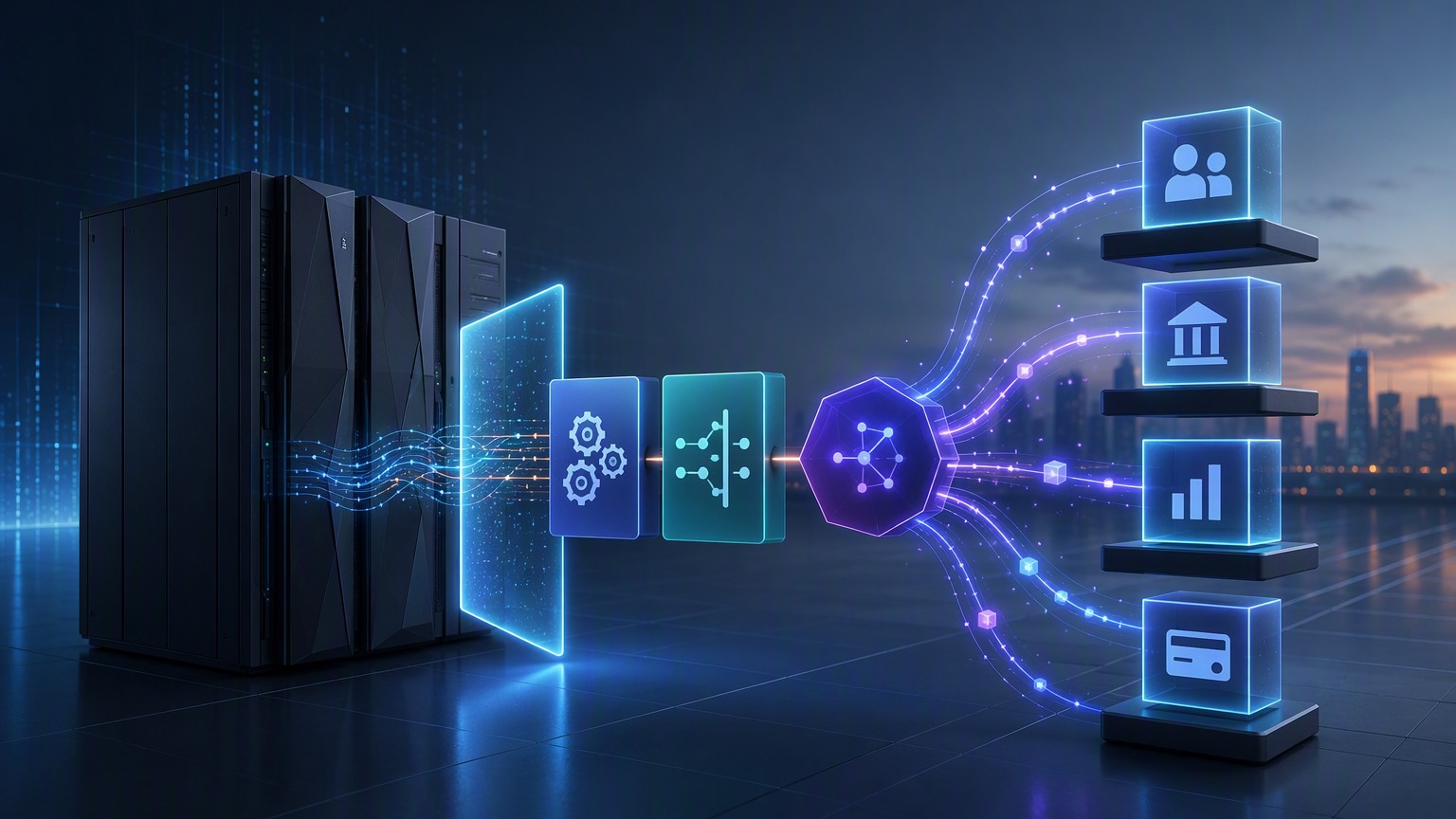
Mainframes often remain at the center of financial and insurance systems because they reliably execute decades of accumulated business rules. The modernization problem is rarely that the mainframe cannot process transactions. The problem is that new applications become coupled to its record layouts, transaction codes, batch schedules, and operational constraints.
Exposing those details through a thin REST wrapper does not solve the problem. It converts a protocol dependency into an API dependency while preserving the same legacy model. Consumers still need to understand fields such as POL-ST-CD, distinguish blank values from zeroes, or coordinate around end-of-day processing.
A stronger approach places a durable enterprise boundary in front of the mainframe. Domain APIs express business capabilities, anti-corruption layers translate between models, adapters isolate transport details, and asynchronous messaging decouples workflows that do not require an immediate answer. Together, these patterns let teams modernize around a mainframe without making it the public architecture.
Treat the mainframe as an implementation detail
The architectural goal is not simply to hide a hostname. It is to prevent mainframe-specific concepts from becoming part of consumer contracts.
A modern policy service, for example, might offer capabilities such as:
- Retrieve policy coverage
- Submit an address change
- Request policy cancellation
- Check the status of a pending change
It should not expose capabilities such as “invoke transaction P142,” “read copybook segment 03,” or “update policy master record.” Those describe implementation mechanisms rather than business intent.
A useful boundary separates four concerns:
flowchart LR
    C[Digital channels and partner systems] --> A[Domain APIs]
    A --> S[Application services]
    S --> P[Ports and enterprise contracts]
    P --> X[Mainframe adapters]
    P --> M[Messaging adapters]
    X --> L[Legacy financial system]
    M --> B[Event broker]
The outer contract remains stable even when the implementation behind it changes. A request might initially be fulfilled through a synchronous mainframe transaction, later through a replicated read model, and eventually by a replacement platform. Consumers should not have to change merely because the fulfillment path changed.
Design APIs around domain intent
A domain API uses language understood by the business and gives each operation explicit semantics. Its resources should not be direct JSON representations of VSAM records, relational tables, copybooks, or screen fields.
Consider an address change. A legacy wrapper might accept a large customer record and require callers to preserve fields they do not own. A domain-oriented API accepts only the intent and information needed for that operation:
POST /policy-changes
Idempotency-Key: 5b0bc0a7-63d8-4cf5-a183-fd65bc92cc19
Content-Type: application/json

{
  "policyId": "P-1048291",
  "changeType": "mailing-address",
  "effectiveDate": "2026-04-01",
  "address": {
    "line1": "18 Market Street",
    "city": "Hartford",
    "region": "CT",
    "postalCode": "06103",
    "country": "US"
  }
}
The response can acknowledge a durable business request without claiming that every downstream update is already complete:
{
  "changeId": "CHG-78210",
  "status": "accepted",
  "submittedAt": "2026-03-10T14:32:08Z",
  "links": {
    "status": "/policy-changes/CHG-78210"
  }
}
This contract makes several deliberate choices:
policyIdis an enterprise identifier, not a database key or packed-decimal field.changeTypeexpresses business intent rather than a transaction code.- Dates and addresses have documented formats and validation rules.
acceptedmeans the request was durably received, not necessarily completed.- An idempotency key lets a client safely retry an uncertain submission.
The API must also define business errors independently of legacy return codes. Consumers can reasonably handle errors such as POLICY_NOT_FOUND, CHANGE_NOT_ALLOWED, and EFFECTIVE_DATE_INVALID. They should never need a manual that explains mainframe response code A17.
Put an anti-corruption layer at the boundary
An anti-corruption layer, or ACL, prevents the legacy model from shaping the modern domain model. It translates data, operations, errors, and temporal behavior in both directions.
This is more than field renaming. A useful ACL may need to:
- Combine multiple legacy records into one domain object
- Split one domain command into several mainframe interactions
- Convert encoded values into documented domain enums
- Distinguish missing, unknown, defaulted, and not-applicable values
- Normalize dates, amounts, currencies, and identifiers
- Convert legacy return codes into stable business outcomes
- Enforce modern authorization and validation rules
- Account for batch windows and deferred processing
Keep this translation explicit and testable. Do not scatter it across controllers, message handlers, and client libraries.
type AddressChange = {
  policyId: string;
  effectiveDate: string;
  address: {
    line1: string;
    city: string;
    region: string;
    postalCode: string;
    country: string;
  };
};

interface PolicyChangePort {
  submitAddressChange(change: AddressChange): Promise<SubmissionResult>;
}

class MainframePolicyChangeAdapter implements PolicyChangePort {
  constructor(private readonly gateway: LegacyTransactionGateway) {}

  async submitAddressChange(change: AddressChange): Promise<SubmissionResult> {
    const request = mapAddressChangeToLegacyRequest(change);
    const response = await this.gateway.execute("ADDRESS_CHANGE", request);
    return mapLegacyResponseToSubmissionResult(response);
  }
}
The application service depends on PolicyChangePort, which is expressed in domain terms. Only the adapter knows how to invoke the legacy gateway or construct its request. The string shown here is internal to the adapter; it must not appear in public schemas, logs intended for consumers, or business events.
The mapping functions deserve focused unit tests using representative fixtures. Edge cases such as fixed-width truncation, EBCDIC conversion, implied decimal positions, sentinel dates, and padded identifiers are integration risks, not trivial serialization details.
Separate anti-corruption logic from transport adapters
The ACL and the adapter are related but not identical:
- Anti-corruption logic translates meaning between domain and legacy models.
- Adapters handle mechanisms such as transaction gateways, queues, files, database access, or terminal automation.
Keeping them separate makes migration easier. If a queue replaces a synchronous gateway, the transport adapter can change while most domain translation remains intact. If the mainframe application is replaced, a new implementation of the same port can be introduced without redesigning the public API.
Use asynchronous messaging where time is not part of the promise
Many mainframe operations are naturally deferred. They may depend on scheduled jobs, human approval, downstream reconciliation, or processing windows. Holding an HTTP connection open does not make those operations synchronous; it only makes their failure behavior harder to manage.
For such workflows, accept the command durably, return a tracking identifier, and process it asynchronously:
sequenceDiagram
    participant Client
    participant API
    participant Store
    participant Broker
    participant Worker
    participant Mainframe

    Client->>API: Submit policy change
    API->>Store: Save request and outbox record
    API-->>Client: 202 Accepted with changeId
    Store->>Broker: Publish command from outbox
    Broker->>Worker: Deliver command
    Worker->>Mainframe: Execute legacy operation
    Mainframe-->>Worker: Return outcome
    Worker->>Store: Update status and save event
    Store->>Broker: Publish completion event
A transactional outbox is important when the API both stores a request and publishes a message. Writing the request and outbox record in one local transaction avoids the failure window in which the database commit succeeds but message publication fails. A relay publishes pending outbox records and marks them delivered.
Message delivery is commonly at least once, so handlers must be idempotent. Store a command or event identifier in an inbox table, or make updates conditional on a durable business operation ID. Do not assume that a broker will deliver each message exactly once across every database, network, and consumer failure.
A production event should carry a stable envelope, for example:
{
  "eventId": "evt-321805",
  "eventType": "PolicyAddressChangeCompleted",
  "eventVersion": 1,
  "occurredAt": "2026-03-10T14:34:51Z",
  "correlationId": "CHG-78210",
  "policyId": "P-1048291",
  "outcome": "completed"
}
Publish business facts, not legacy processing traces. An event named P142TransactionFinished would couple every subscriber to the current implementation. PolicyAddressChangeCompleted describes something meaningful regardless of which platform performed it.
Asynchronous processing adds operational obligations: retry policies, dead-letter handling, status queries, replay controls, ordering decisions, and reconciliation. It is appropriate when the business process tolerates deferred completion, not as a default way to conceal slow dependencies.
Establish stable enterprise contracts
A stable contract is not one that never changes. It is one that changes deliberately, compatibly, and under clear ownership.
Define semantics, not only schemas
OpenAPI, AsyncAPI, JSON Schema, or Protocol Buffers can describe structure, but consumers also need behavioral guarantees:
- What does
accepted,pending, orcompletedmean? - Are monetary amounts decimal strings or minor units?
- Which time zone governs an effective date?
- Can events arrive more than once or out of order?
- How long can a request remain pending?
- Which fields are immutable?
- What happens when a policy is changed concurrently?
Without these definitions, a syntactically valid contract can still be operationally ambiguous.
Prefer additive evolution
Add optional fields and new event types rather than changing the meaning of existing fields. Consumers should ignore fields they do not recognize. Producers should not silently repurpose enum values, alter amount units, or change null from “unknown” to “not applicable.”
Version only when semantics cannot evolve compatibly. Supporting many versions indefinitely is expensive, but forcing coordinated upgrades across dozens of consumers recreates mainframe-style release coupling at the API layer.
Contract tests should verify both sides of the boundary. Consumer-driven tests can protect important client assumptions, while provider tests should confirm that adapters map representative mainframe responses into the documented enterprise model. Schema compatibility checks in delivery pipelines catch structural breaks but cannot replace semantic review.
Engineer for failure and operational isolation
A modern facade cannot make a legacy dependency infinitely available. It can, however, contain failures and communicate them honestly.
Use timeouts based on the business operation rather than generic platform defaults. Bound retries and apply exponential backoff with jitter only to failures likely to be transient. Retrying a validation rejection wastes capacity; retrying a timed-out submission without idempotency can create duplicate financial activity.
Circuit breakers can prevent a failing dependency from consuming all worker or connection capacity, but they require a meaningful fallback. For reads, that may be a timestamped cache or replicated read model if stale data is acceptable. For commands, it may be durable queuing and a pending status. Never return stale financial data as current without making freshness visible.
Also isolate workloads. Online inquiries, high-value commands, and bulk reconciliation should not compete in the same unconstrained pool. Apply queue limits, connection limits, rate controls, and backpressure at the boundary. When capacity is exhausted, reject or defer work explicitly instead of allowing latency to grow without bound.
Observability should cross the boundary without leaking sensitive payloads. Propagate correlation IDs through API requests, messages, adapter calls, and status records. Record latency by stage, queue age, error category, retry count, and reconciliation differences. Avoid logging full account, claim, payment, or policy records; tokenize or redact identifiers according to the organization’s security and retention rules.
Modernize incrementally
A safe modernization program can proceed capability by capability:
- Inventory current consumers and integrations. Include files, queues, direct database reads, shared libraries, and manual operational processes.
- Choose a bounded business capability. Prefer a workflow with clear ownership and measurable outcomes rather than exposing the entire customer or policy record.
- Define the enterprise contract first. Agree on identifiers, states, errors, idempotency, and consistency expectations before selecting the adapter mechanism.
- Implement a port and anti-corruption layer. Put all legacy translation behind the boundary and test difficult record-level cases.
- Select synchronous or asynchronous fulfillment. Base the choice on business timing and consistency requirements, not on a desire to use a particular technology.
- Run reconciliation during transition. Compare accepted requests, legacy outcomes, emitted events, and consumer-visible state. Treat discrepancies as first-class operational work.
- Migrate consumers and remove bypasses. A new API provides little value if teams can continue creating direct dependencies on mainframe data structures.
- Replace internals behind the contract. Route selected operations to new services or data stores only after their behavior matches the established enterprise semantics.
This is effectively a strangler strategy, but the durable asset is the business boundary rather than the temporary routing layer.
Common traps to avoid
Several approaches appear to accelerate delivery but preserve long-term coupling:
- Generating REST endpoints directly from copybooks: fast for transport conversion, but it publishes the legacy data model.
- Sharing canonical models with hundreds of fields: broad reuse often creates a tightly coupled enterprise-wide schema that no team can safely change.
- Returning raw legacy codes: every consumer reimplements translation and may interpret errors differently.
- Publishing database-change events as business events: row updates rarely communicate business intent or transaction boundaries.
- Claiming success before durable acceptance: an HTTP response must distinguish receipt from completion.
- Using dual writes without reconciliation: updating a database and publishing separately creates silent inconsistency during partial failure.
- Putting business rules in each adapter: rules then diverge across synchronous, message, file, and replacement-platform paths.
Conclusion
Modernizing a mainframe integration does not require exposing the mainframe through newer protocols. The more durable design is a domain boundary that expresses business capabilities and shields consumers from records, transaction codes, batch behavior, and transport constraints.
Domain APIs define intent, anti-corruption layers preserve model independence, adapters isolate mechanisms, and asynchronous messaging supports workflows that are genuinely deferred. Stable enterprise contracts then allow both consumers and implementations to evolve without coordinated rewrites.
The mainframe can continue doing what it does well while becoming one replaceable implementation behind a carefully owned boundary. That is the foundation for incremental modernization without turning legacy details into permanent enterprise contracts.