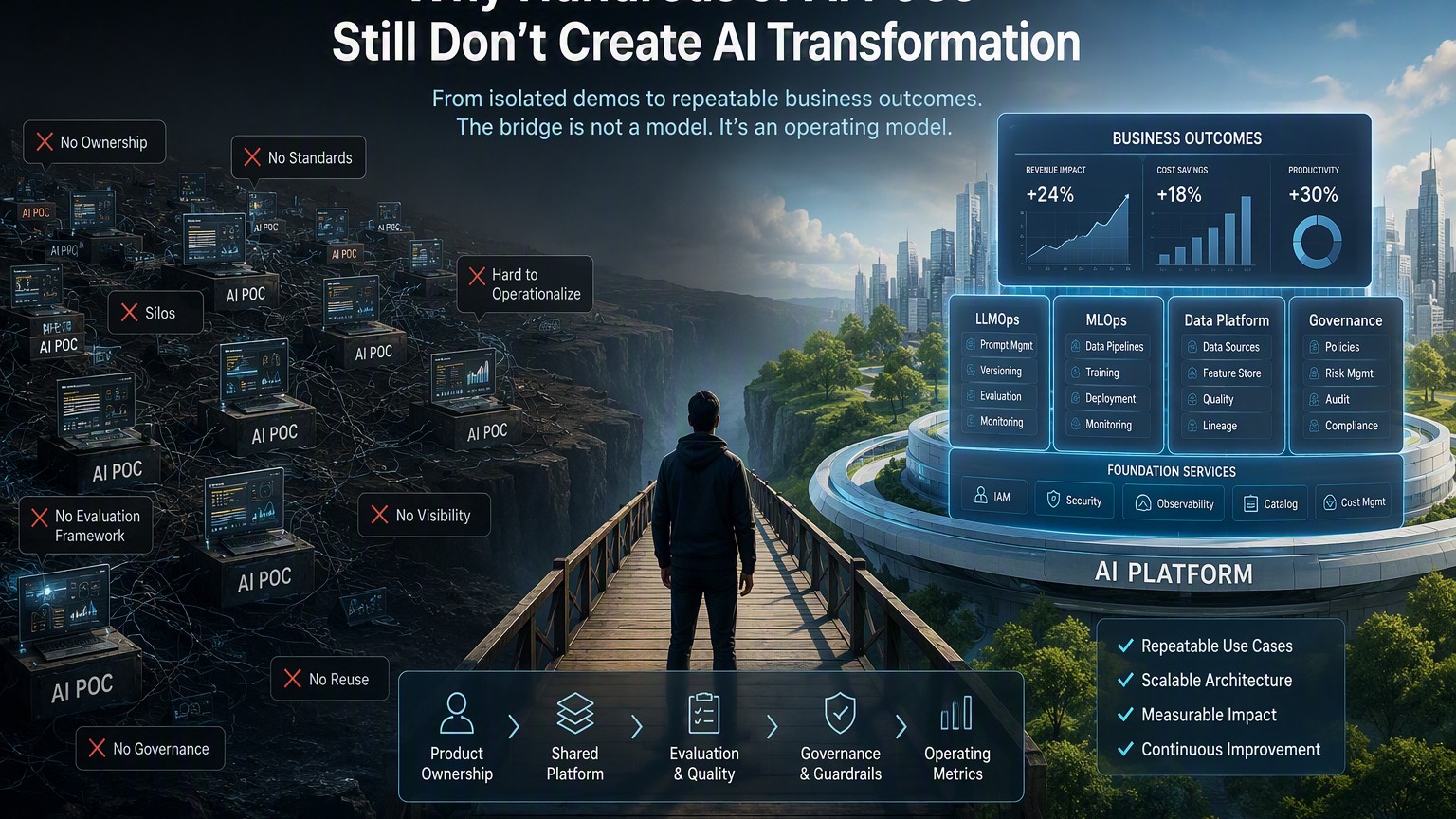
Enterprise AI governance often begins with a reasonable goal: prevent sensitive data exposure, unsafe automation, regulatory violations, and unaccountable decisions. It becomes a delivery problem when every prototype, model change, or prompt update requires the same lengthy approval process.
That approach does not eliminate risk. It moves experimentation into unmanaged accounts, local scripts, and unofficial tools where security and platform teams have even less visibility.
Effective governance works differently. It establishes boundaries within which teams can move quickly, reserves deeper review for genuinely consequential use cases, and automates controls that do not require human judgment. The objective is not unrestricted AI adoption. It is controlled autonomy: engineers receive a fast, clearly documented path for low-risk work, while high-risk systems receive proportionate scrutiny.
Start with the decisions governance must support
An AI governance program should help the organization answer practical questions:
- What data may this system access?
- What actions can it take, and can those actions be reversed?
- Who is affected if it produces a wrong or harmful result?
- How will operators detect failures, investigate incidents, and disable the system?
- Who owns the system after deployment?
- Which changes require renewed review?
Governance becomes slow when these questions are converted into a single universal approval gate. A customer-support summarizer operating on already-authorized tickets does not present the same risk as a system that automatically denies transactions or ranks job applicants. Applying identical controls to both wastes reviewer capacity and encourages teams to treat governance as paperwork.
The better model is to classify the use case, apply controls associated with that class, and escalate only when human judgment is necessary.
Use risk tiers instead of one approval process
Risk classification should be simple enough that engineers can use it during design, not only after implementation. A useful assessment considers at least four dimensions:
- Data sensitivity: public, internal, confidential, regulated, or highly restricted.
- Decision impact: informational assistance, recommendation, or autonomous decision.
- Affected parties: employees, customers, applicants, patients, or the general public.
- Operational reach: isolated prototype, internal workflow, customer-facing feature, or action across production systems.
These dimensions can map to a small number of tiers. The exact names matter less than the controls attached to them.
| Tier | Typical use case | Example controls | Review path |
|---|---|---|---|
| Low | Experiments using synthetic or public data | Approved environment, logging, spending limit | Self-service |
| Moderate | Internal assistance using authorized enterprise data | Access controls, evaluation set, output review, retention rules | Automated checks plus owner approval |
| High | Customer-facing recommendations or tools handling regulated data | Security and privacy review, adversarial testing, monitoring, rollback plan | Specialist review |
| Critical | Autonomous or legally consequential decisions | Formal impact assessment, independent validation, human appeal path, executive risk acceptance | Governance committee |
A tier is not merely a label. It is a control bundle. Teams should know exactly what evidence is required, which checks are automated, who may approve the system, and how long an approval remains valid.
flowchart TD
    A[Register AI use case] --> B{Sensitive data?}
    B -- No --> C{External or autonomous action?}
    B -- Yes --> D[Moderate or higher tier]
    C -- No --> E[Low-risk safe path]
    C -- Yes --> F[High-risk review]
    D --> G{Material impact on people?}
    G -- No --> H[Moderate controls]
    G -- Yes --> F
    E --> I[Automated checks and deploy]
    H --> J[Owner approval and deploy]
    F --> K[Specialist review]
This diagram is intentionally simpler than a complete policy. Classification logic must reflect the enterprise's legal obligations and risk appetite. The important design choice is that low-risk work exits quickly, rather than entering the same queue as high-impact systems.
Define paved roads for common AI workloads
A policy that says what teams cannot do is incomplete. Engineers also need an approved way to accomplish common tasks.
A paved road is a supported combination of infrastructure, configuration, controls, and documentation. For example, an enterprise might provide:
- A model gateway with authentication, provider allowlists, request limits, and audit metadata.
- A retrieval service that enforces document permissions before returning context.
- Standard application templates with tracing, feedback capture, and kill switches.
- Approved storage patterns for prompts, outputs, evaluation data, and user feedback.
- A deployment pipeline that records model, prompt, dataset, and policy versions.
- Synthetic or de-identified datasets for experimentation.
Teams using the paved road should receive faster approval because major architectural questions have already been resolved. A team that bypasses it may still proceed, but it must explain the deviation and supply equivalent controls.
Safe paths should not become frozen platforms. Model capabilities, provider terms, and attack techniques change. Platform teams need a regular process for updating approved components while preserving compatibility and an auditable change history.
Make the default path the easiest path
Controls fail when compliant development requires more effort than an unmanaged workaround. Good defaults reduce that incentive:
- Disable provider-side training or retention where contracts and configuration support it.
- Prevent secrets and restricted data from entering prompts through both access design and detection controls.
- Attach application identity, owner, environment, and data classification to every request.
- Set conservative quotas and timeouts by default.
- Keep tools read-only until write access is explicitly justified.
- Require confirmation before irreversible or high-impact actions.
These defaults should be enforced centrally where possible. Asking every application team to reproduce them leads to inconsistent behavior and duplicated work.
Automate objective controls; reserve people for judgment
Human review is valuable when the decision requires context, interpretation, or risk acceptance. It is expensive and unreliable when reviewers are manually checking whether a repository contains a particular file or whether encryption is enabled.
Automate controls such as:
- Approved model and provider checks.
- Infrastructure policy validation.
- Secret scanning and dependency analysis.
- Data classification and access-policy checks.
- Presence of an owner, system description, and incident contact.
- Required evaluation results and release thresholds.
- Logging, retention, and region configuration.
- Expiration dates for temporary exceptions.
An internal policy record might look like the following. This is an illustrative schema, not a standard API:
system:
  name: ticket-summary-service
  owner: support-platform
  environment: production

risk:
  tier: moderate
  data_classes:
    - confidential
  external_decision: false
  autonomous_actions: false

controls:
  approved_model: true
  permission_aware_retrieval: true
  human_reviews_output: true
  audit_logging: true
  rollback_documented: true

change_triggers:
  - new_data_class
  - autonomous_action_added
  - customer_facing_output
A CI policy engine can validate the shape and objective claims, compare referenced infrastructure with deployed configuration, and route exceptions to the appropriate owner. It should not blindly trust approved_model: true; that value needs to be derived from or checked against an authoritative model registry.
The tradeoff is maintenance. Automated policy can create false confidence if controls drift from real infrastructure, and overly broad scanners can block legitimate changes. Treat policy code like production software: version it, test it against representative cases, monitor false positives, and assign maintainers.
sequenceDiagram
    participant Dev as Engineering team
    participant CI as Delivery pipeline
    participant Policy as Policy engine
    participant Review as Risk specialist
    participant Runtime as AI runtime

    Dev->>CI: Submit application and risk record
    CI->>Policy: Evaluate code, config, and metadata
    Policy-->>CI: Pass, fail, or escalate
    alt Low or moderate risk and checks pass
        CI->>Runtime: Deploy with required controls
    else Judgment or exception required
        CI->>Review: Send focused evidence package
        Review-->>CI: Approve, reject, or request changes
        CI->>Runtime: Deploy if approved
    end
Reviewers should receive a focused evidence package, not a blank questionnaire. It can include the proposed data flow, risk tier, failed or non-applicable controls, evaluation results, threat model, and requested exception. This shortens review while improving its quality.
Govern the system, not only the model
Model approval alone is insufficient. The same model can be low risk in a brainstorming tool and high risk when connected to payment, identity, or production administration systems.
Governance must cover the complete application:
- Inputs: data sources, consent, permissions, and prompt injection exposure.
- Context: retrieval boundaries, tenant isolation, and document provenance.
- Model: provider, version, deployment region, and relevant limitations.
- Tools: callable operations, authorization, transaction limits, and reversibility.
- Outputs: presentation, human review, downstream consumers, and persistence.
- Operations: telemetry, incident response, rollback, and ownership.
Tool use deserves special attention. An assistant that drafts a database query differs materially from an agent allowed to execute it. Prefer staged authority: generate a plan, validate it, request confirmation where needed, then execute using an identity with narrowly scoped permissions. Do not rely on model instructions as an authorization boundary.
Evaluations should also reflect the application rather than abstract model quality. A support summarizer may need tests for factual consistency, omission of critical details, sensitive-data handling, and behavior on malformed tickets. A tool-using system additionally needs tests for unauthorized actions, duplicate execution, argument validation, and recovery from partial failures.
Make review triggers explicit
Teams should not have to guess whether every prompt edit requires reapproval. Define material change triggers in advance.
Reassessment is usually warranted when a system:
- Begins processing a more sensitive data class.
- Adds a new user population or external audience.
- Moves from recommendation to autonomous action.
- Gains access to a new tool or production system.
- Changes its purpose or materially affects a regulated workflow.
- Switches model or provider in a way that changes data handling or risk assumptions.
- Falls below agreed safety or quality thresholds.
By contrast, a wording change that remains within tested behavior may require only automated evaluation and routine deployment. Version prompts, models, retrieval configuration, tools, and evaluation suites so the organization can identify what changed and reproduce an incident.
Build an exception path that does not hide risk
No control framework anticipates every valid design. Teams need an exception process, but exceptions should be visible, narrow, and temporary.
A useful exception records:
- The control that cannot be met.
- The business and technical justification.
- Compensating controls.
- The accountable risk owner.
- Scope and expiration date.
- Conditions that revoke the exception.
For example, an early prototype might receive a time-limited exception from a standard evaluation threshold if it uses synthetic data, remains inaccessible to customers, cannot call external tools, and has a strict user cap. The exception allows learning without quietly authorizing production use.
Avoid permanent waivers stored in email or ticket comments. Track exceptions as structured records and alert owners before expiration.
Operate governance as a measurable product
Governance teams have users: engineers, reviewers, security teams, legal teams, and business owners. Measure whether the system protects the enterprise and enables responsible delivery.
Useful operational metrics include:
- Median time to classify and approve by risk tier.
- Percentage of systems using approved paved roads.
- Percentage of reviews completed automatically.
- Exception volume, age, and recurrence.
- Policy false-positive and override rates.
- Inventory coverage for deployed AI systems.
- Incidents and near misses by control failure.
- Time to identify an owner and disable an affected system.
Do not optimize only for approval speed. A five-minute process that collects unreliable declarations is not strong governance. Likewise, the number of blocked projects is not evidence of safety. The goal is timely, accurate routing and controls that remain effective in production.
Create a feedback loop between runtime incidents and design-time policy. If several systems leak sensitive context because retrieval permissions were copied into application code incorrectly, the response should not be another questionnaire. Build permission enforcement into the shared retrieval layer and add an automated integration test.
A practical adoption sequence
Enterprises do not need a perfect framework before allowing useful work. A pragmatic rollout can proceed in stages:
- Inventory existing systems. Record owners, purpose, data classes, providers, users, and production access.
- Define prohibited uses and escalation criteria. Keep the list short, specific, and linked to accountable decision-makers.
- Establish three or four risk tiers. Attach concrete controls and review owners to each tier.
- Launch one paved road. Target a common workload such as internal summarization or retrieval-assisted search.
- Automate objective checks. Integrate policy validation into repositories and deployment pipelines.
- Add runtime evidence. Capture versions, access decisions, tool calls, failures, and operator actions without indiscriminately logging sensitive content.
- Review outcomes quarterly. Update tiers, controls, and safe paths based on incidents, exceptions, developer feedback, and changing obligations.
Start with controls that reduce real risk and can be implemented consistently. A large governance catalog with unclear ownership is less useful than a smaller set of enforceable requirements.
Conclusion
AI governance should make the safe way obvious, fast, and observable. Risk tiers prevent low-impact experiments from competing with consequential systems for reviewer attention. Paved roads embed proven controls into the engineering workflow. Automation handles objective checks, while specialists focus on decisions requiring context and judgment.
The result is not lighter governance. It is more precise governance: strict where harm could be significant, flexible where experimentation is contained, and continuously improved through operational evidence. That is how a governance program becomes a guardrail teams can build against rather than a gate they learn to avoid.