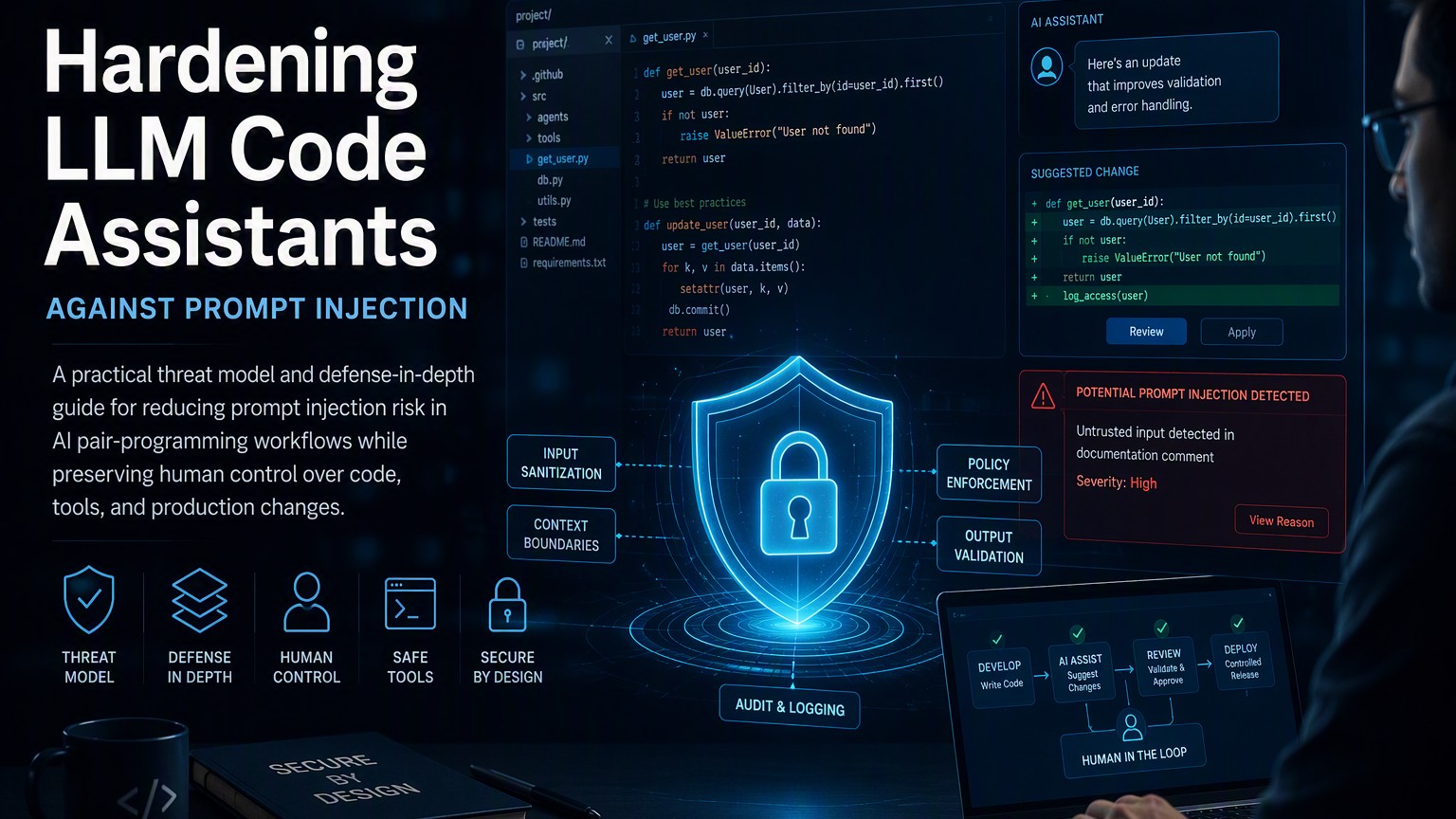
AI pair-programming tools have moved from generating isolated completions to editing repositories, running commands, and opening pull requests. That expanded capability changes the governance problem. A policy document and an annual audit are not enough when an agent can make consequential decisions in seconds.
Engineering organizations need a closed control loop: observe how assistants are used, evaluate each action against versioned policy, enforce decisions at trusted boundaries, and feed operational findings back into policy design. The objective is not employee surveillance or a dashboard of generated lines. It is to make AI-assisted development measurable, reviewable, and safe enough for routine production use.
This article presents a vendor-neutral design for that loop, including event schemas, drift indicators, productivity measures, enforcement points, and privacy constraints.
Treat telemetry as part of the control plane
Traditional developer tooling telemetry often answers product questions such as which commands are popular. Governance telemetry must answer harder operational questions:
- Which policy governed an action, and what decision did it produce?
- Are developers or agents repeatedly attempting disallowed operations?
- Is a new plugin version bypassing expected checks?
- Are AI-assisted changes improving flow without increasing defects or rework?
- Can investigators reconstruct an incident without storing prompts or source code?
Telemetry alone cannot enforce policy. An IDE extension runs on a developer-controlled workstation and may be disabled, outdated, or modified. It is useful for immediate feedback, but authoritative controls belong at boundaries the organization manages: model gateways, secret brokers, execution sandboxes, source-control checks, and CI/CD systems.
A practical architecture separates collection, decision, and enforcement:
flowchart LR
    IDE[IDE plugin] --> LP[Local policy check]
    Agent[Coding agent] --> LP
    LP --> GW[Model and tool gateway]
    GW --> PE[Policy engine]
    GW --> Model[Approved model endpoint]
    GW --> Sandbox[Execution sandbox]
    IDE --> OT[Telemetry collector]
    Agent --> OT
    GW --> OT
    PE --> OT
    OT --> Stream[Event pipeline]
    Stream --> Monitor[Drift and risk monitors]
    Stream --> Metrics[Engineering metrics]
    Stream --> Audit[Restricted audit store]
Local checks provide low-latency guidance, such as warning that a file is classified as restricted. The gateway repeats the evaluation using trusted identity and repository data. This avoids relying on the client while still giving the developer a fast, understandable response.
Define a stable event contract
Instrumentation becomes difficult to operate when every plugin emits different fields. Define a small, versioned contract that represents an action and its policy decision. Useful fields include:
- A random event or trace identifier
- Pseudonymous actor, repository, and organization identifiers
- Client type and version
- Action type, such as completion, file edit, command execution, or pull-request creation
- Policy identifier, version, decision, and reason code
- Model or tool class, using an approved internal identifier
- Coarse input and output sizes when available
- Latency, error category, and final outcome
- Data-classification level and execution environment
Do not put source code, prompts, file contents, credentials, command output, or full file paths into general-purpose telemetry. If incident response requires content capture, make it a separate, access-controlled workflow with explicit retention and authorization.
OpenTelemetry traces, metrics, and logs can carry this data, but the organization must define its own semantic conventions. The following TypeScript example records an interaction without recording its content:
import { trace } from "@opentelemetry/api";

const tracer = trace.getTracer("coding-assistant");

export async function recordInteraction(ctx: InteractionContext) {
  const span = tracer.startSpan("assistant.interaction", {
    attributes: {
      "assistant.action": ctx.action,
      "assistant.client_version": ctx.clientVersion,
      "assistant.repo_key": ctx.pseudonymousRepoKey,
      "assistant.policy_id": ctx.policyId,
      "assistant.policy_version": ctx.policyVersion,
      "assistant.decision": ctx.decision,
      "assistant.reason_code": ctx.reasonCode,
      "assistant.data_class": ctx.dataClass
    }
  });

  try {
    const result = await ctx.perform();
    span.setAttribute("assistant.outcome", result.outcome);
    span.setAttribute("assistant.latency_ms", result.latencyMs);
    return result;
  } catch (error) {
    span.setAttribute("assistant.outcome", "error");
    span.setAttribute("assistant.error_type", classifyError(error));
    throw error;
  } finally {
    span.end();
  }
}
The pseudonymous repository key should be generated with a keyed hash or mapping service, not a plain hash of a predictable repository name. Error classification should produce bounded categories rather than exception messages, which may contain code or secrets. Keep high-cardinality identifiers out of metric labels; retain them only in access-controlled traces or logs when investigation requires correlation.
Detect policy drift as an observable condition
Policy drift occurs when intended rules and actual behavior diverge. It can result from stale clients, incomplete integrations, configuration changes, emergency exceptions, or new agent capabilities that existing rules do not cover.
Start by emitting a decision event for every governed action. Include the policy version and a stable reason code such as MODEL_NOT_APPROVED, RESTRICTED_DATA, TOOL_NOT_ALLOWED, or POLICY_UNAVAILABLE. Then monitor for patterns including:
- Actions evaluated under deprecated policy versions
- Requests to unapproved models or tools
- Sudden changes in allow, deny, or exception rates after a release
- Agent actions with no corresponding policy decision
- Repeated attempts after a denial
- Repositories whose data classification is unknown
- Telemetry volume that falls below expected gateway traffic
- Exceptions that remain active beyond their expiration date
The most important control is reconciliation. Compare independent sources rather than assuming emitted events are complete. For example, model gateway request counts should approximately reconcile with policy decision counts, while sandbox job records should reconcile with agent execution events. A missing event is itself a governance signal.
Use deployment annotations and policy versions when alerting. A denial-rate increase immediately after a stricter policy release may be expected; the same increase without a change may indicate a compromised client or newly adopted workflow. Alert on sustained changes and absolute risk events rather than minor percentage fluctuations in small samples.
Measure productivity without rewarding unsafe behavior
Completion acceptance rate and generated lines of code are easy to collect but weak measures of engineering value. They reward volume, ignore deleted or rewritten output, and can encourage developers to accept suggestions prematurely.
Measure outcomes at the team or service level across the delivery lifecycle. Useful indicators include:
- Time from work start to first reviewable change
- Pull-request lead time and review wait time
- Time to first passing build or test run
- Review revisions and post-review rework
- Change failure, rollback, and hotfix rates
- Defects associated with recently changed components
- Developer-reported cognitive load and task fit
Telemetry can link an AI-assisted session to a pull request through short-lived correlation identifiers, without retaining prompts. Aggregate results over teams and meaningful time windows. Avoid individual rankings: they create incentives to game instrumentation and fail to account for task complexity, mentoring, incident response, or maintenance work.
AI usage is not randomly assigned, so a simple comparison of users and non-users is misleading. Developers may select assistants for either trivial tasks or unusually difficult ones. Prefer staged rollouts, matched repositories or teams, and interrupted time-series analysis. Track quality and security outcomes alongside speed. A reduction in lead time is not a gain if rework or escaped defects increase.
Telemetry should also distinguish modes. Inline completion, conversational explanation, multi-file editing, and autonomous execution have different risk and productivity profiles. Combining them into one adoption metric hides the operational questions leaders actually need to answer.
Enforce policy at each consequential step
Guardrails should be proportional to capability. Reading an approved file for a completion is different from running a shell command or publishing a package. Model actions as explicit capabilities and evaluate policy before granting each one.
sequenceDiagram
    participant D as Developer
    participant I as IDE or agent
    participant G as Trusted gateway
    participant P as Policy engine
    participant T as Tool sandbox

    D->>I: Request change
    I->>G: Request capability
    G->>P: Evaluate identity context and action
    P-->>G: Allow deny or require approval
    G-->>I: Decision with reason code
    I->>T: Execute approved action
    T-->>G: Execution outcome
    G-->>I: Result
An internal policy evaluator might return a deliberately small decision object:
type Decision = {
  effect: "allow" | "deny" | "require_approval";
  policyId: string;
  policyVersion: string;
  reasonCode: string;
  expiresAt?: string;
};

function evaluate(action: Action, context: Context): Decision {
  if (context.dataClass === "restricted" && action.destination === "external") {
    return deny("RESTRICTED_DATA");
  }

  if (action.type === "execute_command" && !context.sandboxed) {
    return requireApproval("UNSANDBOXED_EXECUTION");
  }

  if (!context.approvedTools.includes(action.toolId)) {
    return deny("TOOL_NOT_APPROVED");
  }

  return allow("BASELINE_POLICY");
}
This is intentionally a domain interface rather than a dependency on a particular policy product. Stable effects and reason codes make clients predictable, while policy implementation can evolve behind the interface.
For command execution, combine policy with technical containment: isolated workspaces, explicit network egress rules, scoped credentials, CPU and time limits, and an immutable execution record. Human approval is not a substitute for containment; reviewers can miss a dangerous command, especially when prompts are frequent.
Define failure behavior per capability. If the policy service is unavailable, read-only suggestions involving non-sensitive repositories might fail open for a short, bounded period using a cached signed policy. Secret access, production changes, external publication, and privileged execution should fail closed. Record fallback use and alert on it so degraded operation does not become permanent policy.
Make governance understandable and privacy-preserving
A denied action should tell the developer what category of rule applied and how to proceed. “Blocked by policy” creates support load and encourages bypasses. Prefer messages such as: “External model access is unavailable for restricted repositories. Use the approved internal route or request a time-limited exception.” Do not reveal sensitive detection details that would make controls easier to evade.
Exceptions should be structured records with an owner, scope, justification, approver, and expiration. The policy engine should evaluate them like any other rule, and telemetry should distinguish exception-based allows from normal allows.
Apply conventional data governance to the telemetry itself:
- Collect the minimum fields needed for stated purposes.
- Separate operational metrics from restricted audit evidence.
- Encrypt data in transit and at rest.
- Limit access by role and log access to audit data.
- Use documented retention periods and deletion processes.
- Publish what is collected and prohibit performance ranking of individuals.
- Threat-model telemetry fields for source-code, secret, and identity leakage.
Sampling is appropriate for performance traces but dangerous for security decisions. Preserve all deny, exception, privileged-action, and fallback events. Routine allowed completions can be sampled or aggregated, provided reconciliation remains possible.
Roll out the control loop incrementally
Begin with observation rather than immediate blocking. Instrument one client and one trusted gateway, validate event completeness, and run policies in shadow mode. Compare the hypothetical decisions with actual workflows to find ambiguous classifications and missing context.
Next, enforce a small set of high-confidence controls, such as blocking known unapproved destinations for restricted repositories. Add approval paths before expanding into agent execution. Every policy release should have an owner, test cases, a version, rollback instructions, and dashboards segmented by policy version.
A production readiness review should verify:
- Clients never send prompt or source content to standard telemetry.
- Authoritative checks run outside the IDE.
- Policy and execution events can be reconciled.
- High-risk actions fail safely during dependency outages.
- Exceptions expire automatically.
- Productivity reporting includes quality measures and team-level aggregation.
- Developers can understand denials and report false positives.
Conclusion
Telemetry-driven guardrails turn AI pair programming from an unmanaged client feature into an observable engineering system. The effective pattern is a closed loop: emit privacy-conscious events, make versioned policy decisions at trusted boundaries, reconcile independent records, and evaluate delivery speed together with quality and risk. Done well, governance becomes part of normal developer flow rather than a separate audit exercise—and coding agents can gain capabilities without gaining unchecked authority.