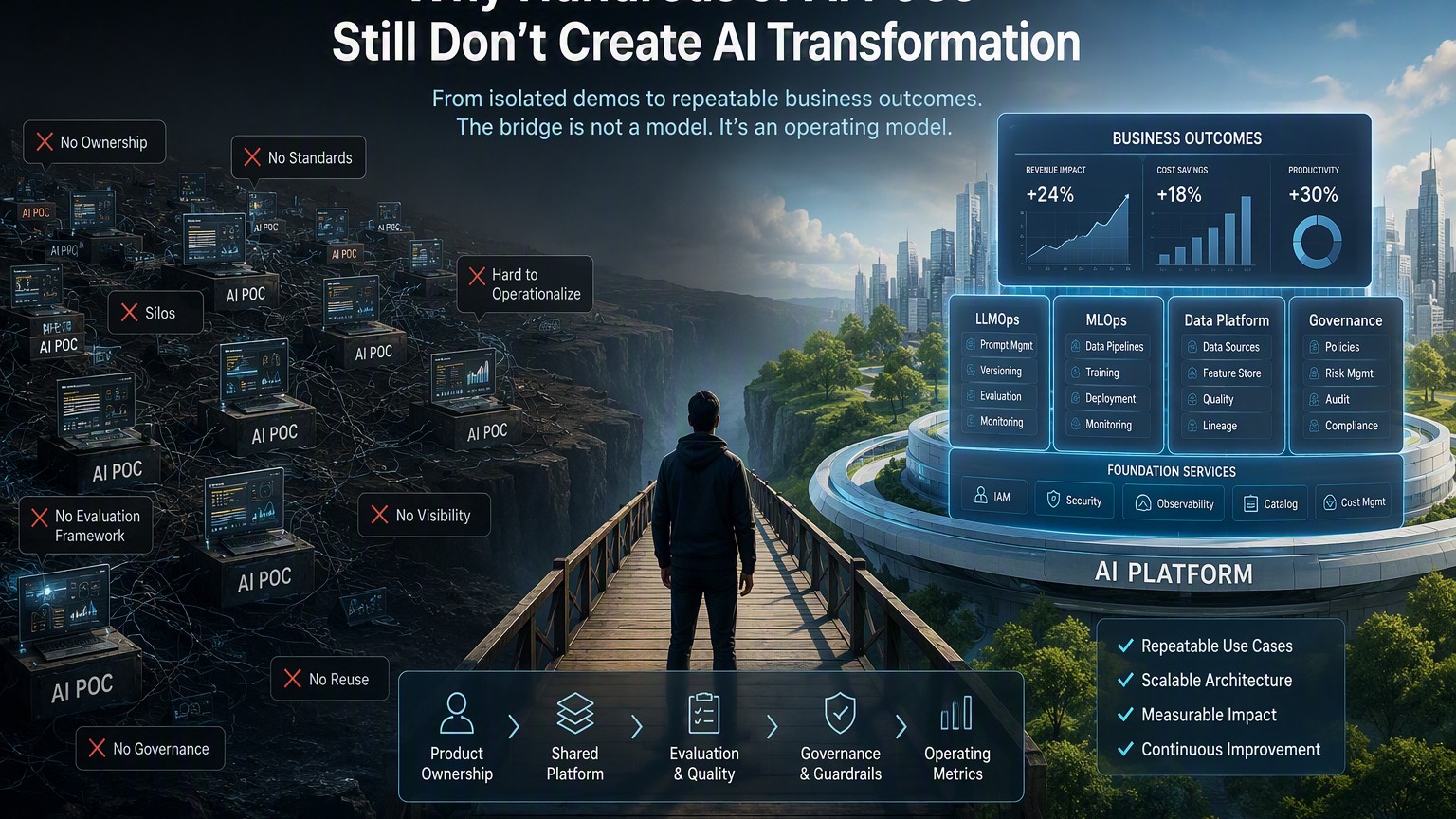
Japan has excellent engineers, globally competitive companies, deep industry knowledge, and enormous potential for AI. Yet many enterprise AI initiatives struggle to move beyond demonstrations and proof-of-concept projects.
The usual explanation is technical: insufficient data, model accuracy, security, legacy systems, or a shortage of AI specialists. Those constraints are real, but they are rarely the whole story.
The deeper difficulty is that AI delivery conflicts with organizational systems designed to prevent mistakes. AI creates value through repeated experimentation: deploy a bounded capability, observe real behavior, measure outcomes, correct failures, and expand carefully. An organization that requires certainty before action removes the feedback loop that makes AI improve.
This is not a claim that every Japanese company operates the same way, nor are these habits unique to Japan. Regulated enterprises around the world face similar problems. However, consensus-heavy decision-making, extensive approval chains, strict quality expectations, and organizational separation can make the tension especially visible in large Japanese companies.
The result is a widening gap between companies doing AI and companies performing AI activity.
Two AI operating models
A company doing AI usually follows a simple cycle:
Start small → ship → measure → learn → improve → scale
A company performing AI activity may follow a very different cycle:
Committee → strategy deck → PoC → steering committee → another PoC → announcement
Both can report significant AI investment. Both can employ talented engineers and produce impressive demonstrations. But only the first is continuously accumulating production experience.
flowchart LR
    A[Bounded idea] --> B[Production release]
    B --> C[Measure outcomes]
    C --> D[Review failures]
    D --> E[Improve controls and product]
    E --> B
That experience includes knowledge that cannot be obtained from a strategy document:
- How users phrase real requests
- Which errors are merely inconvenient and which are dangerous
- Where human review adds value
- What latency and cost are acceptable
- Which data is genuinely missing
- How employees adapt their workflows
- What monitoring, rollback, and escalation procedures operations teams need
AI transformation is therefore not primarily the adoption of models. It is the development of an organizational capability to learn safely and quickly.
Why established operating habits collide with AI
Consensus before experimentation
Consensus is valuable when a decision is expensive or difficult to reverse. It becomes costly when every small, reversible experiment is treated like a permanent enterprise commitment.
An AI assistant tested with ten support agents for two weeks should not require the same decision process as replacing the company-wide customer service platform. If those decisions enter the same approval path, the experiment may take longer to approve than to build.
The solution is not to eliminate consensus. It is to establish consensus around the boundaries of experimentation:
- Which data classifications are permitted?
- How many users may participate?
- What actions must require human approval?
- What is the maximum budget and duration?
- Which metrics determine continuation or shutdown?
Once those boundaries are approved, teams should be able to run experiments without restarting the organizational decision process each time.
Zero-risk thinking before learning
No production system is risk-free. Traditional software can fail because of defects, configuration errors, infrastructure problems, or misunderstood requirements. AI adds probabilistic behavior: the same system may produce outputs of varying quality even when the infrastructure works correctly.
Trying to eliminate that uncertainty before release is usually impossible. A better approach is to control exposure.
For example, an internal knowledge assistant can begin with:
- Read-only access to approved documents
- A limited employee group
- Source citations shown with every answer
- No automatic business actions
- Logging with appropriate privacy controls
- A visible feedback and escalation mechanism
- A kill switch or feature flag
This design does not claim the assistant is always correct. It makes incorrect behavior detectable, containable, and reversible.
Perfect data before starting
“Data is not ready” can be a legitimate diagnosis. It can also become a permanent reason not to learn.
Teams often assume they must clean every document, unify every schema, and complete an enterprise data platform before testing an AI use case. That creates a large dependency chain with uncertain business value.
A narrower experiment can reveal which data work is actually necessary. A retrieval system may show that the main problem is not document formatting but outdated ownership metadata. A forecasting model may reveal that one operational signal matters more than dozens of fields included in the original data program.
The practical principle is:
Improve data in response to a bounded use case, not only in anticipation of every possible use case.
This does not justify careless governance. Sensitive data still requires classification, access control, retention rules, and auditability. The distinction is between safe enough to learn and perfect enough for every future scenario.
Many approvals before small decisions
Approval chains introduce decision latency. That latency compounds across model selection, data access, security review, prompt changes, user onboarding, evaluation criteria, and production deployment.
Consider a team that needs five business days for each approval. If six decisions occur sequentially, a small experiment can accumulate a month of waiting before engineering work or user feedback begins.
The answer is not to bypass security, legal, or business owners. It is to separate decisions by reversibility and impact:
| Decision type | Example | Appropriate governance |
|---|---|---|
| Reversible and low impact | Change a system prompt for 20 internal users | Team-owned change with logging |
| Reversible and moderate impact | Add an approved internal data source | Predefined security review |
| High impact | Generate customer-facing financial guidance | Formal risk and legal approval |
| Difficult to reverse | Automate a regulated business decision | Executive ownership and extensive validation |
When every change receives maximum governance, teams avoid changing anything. When governance is proportional to impact, control becomes compatible with learning.
PoCs before production
A proof of concept answers a narrow question: Can this idea work under selected conditions? Production answers a harder question: Can this capability operate reliably inside the business?
PoCs often exclude the work where enterprise value is won or lost:
- Identity and access management
- Data ownership and lifecycle controls
- Evaluation against representative cases
- Cost and latency budgets
- Monitoring and incident response
- User support and training
- Model or provider changes
- Integration with existing workflows
- Accountability for business outcomes
Repeated PoCs can create an illusion of progress while avoiding operational responsibility. A better early milestone is not “demo completed,” but smallest production-safe release completed.
Build a production learning loop, not a showcase
A production AI system needs more than a model endpoint. It needs controls around inputs, outputs, actions, and feedback.
flowchart TD
    U[User request] --> P[Policy and input checks]
    P --> R[Retrieval or model workflow]
    R --> O[Output validation]
    O --> H{High impact action?}
    H -- Yes --> V[Human review]
    H -- No --> D[Deliver result]
    V --> D
    D --> M[Metrics and feedback]
    M --> E[Evaluation dataset]
    E --> R
The important architectural property is the feedback path. Production interactions—handled according to privacy and retention policies—should improve evaluation. Evaluation should then inform prompts, retrieval, models, controls, and product design.
A simple release policy might be expressed as configuration rather than scattered application logic:
ai_release:
  enabled_groups:
    - support_pilot
  allowed_data_classes:
    - internal
  prohibited_actions:
    - issue_refund
    - modify_customer_record
  require_human_review:
    - external_message
  limits:
    requests_per_user_per_day: 30
    monthly_cost_usd: 1000
  rollback:
    feature_flag: support_assistant_v1
The exact fields will vary by organization. The design tradeoff is more important than the syntax: policy should be explicit, reviewable, and adjustable without redesigning the entire application.
Feature flags and usage limits reduce exposure, but they are not complete security controls. Authorization must still be enforced by the underlying systems. A prompt saying “do not reveal confidential data” is not a substitute for access control.
Measure organizational throughput, not AI activity
Many AI programs track inputs:
- Number of workshops
- Number of PoCs
- Number of employees trained
- Number of tools evaluated
- Amount of budget allocated
These may indicate activity, but they do not show whether the organization is learning or creating value.
More useful measures include:
- Time from approved idea to first production user
- Percentage of experiments reaching a production-safe pilot
- Time required to approve a low-risk change
- Frequency of releases and controlled rollbacks
- Percentage of outputs reviewed or corrected by users
- Task completion time before and after introduction
- Cost per successfully completed task
- Number of evaluation cases derived from real failures
Accuracy alone is insufficient. A system can score well on an offline test and still fail because users do not trust it, integration adds friction, latency is excessive, or the wrong business task was automated.
Metrics should connect technical quality to operational outcomes. For a support assistant, that may mean tracking grounded-answer quality alongside handling time, escalation rate, agent adoption, and correction frequency.
A practical operating model for Japanese enterprises
The following model preserves necessary governance while reducing the cost of experimentation.
1. Select a bounded workflow
Choose a repetitive, measurable task with a known owner. Prefer internal assistance or decision support over autonomous, customer-facing actions for the first release.
Good candidates have:
- A clear user group
- Existing examples of successful work
- Measurable time or quality outcomes
- Failures that can be reviewed and corrected
- Data that can be accessed lawfully and securely
2. Define the risk envelope before building
Document permitted users, data, actions, duration, spending, review requirements, and shutdown conditions. Ask security, legal, and business leaders to approve this envelope once.
This moves consensus to the correct level: the rules of the experiment, rather than every implementation detail.
3. Name one accountable product owner
Cross-functional participation is necessary; collective ambiguity is not. One person should own the use case, user outcome, release decision, and learning backlog.
A steering committee may resolve escalated risks, but it should not become the product manager for routine changes.
4. Ship to real users with reversible controls
Deploy behind a feature flag, limit the audience, log important events, establish a rollback process, and provide human review where consequences are meaningful.
A production pilot should use real workflows and operational controls. Otherwise, it is still a demonstration.
5. Review evidence on a fixed cadence
A weekly review can examine failures, user corrections, cost, latency, incidents, and outcome metrics. Decisions should be explicit: continue, modify, expand, pause, or stop.
Stopping a weak experiment is not failure. Spending another six months protecting it because the organization announced an AI initiative is failure to learn.
6. Scale controls and experience together
Do not jump from 20 internal users to an enterprise-wide rollout based only on enthusiasm. Expand by user group, data class, workflow, or action authority. Each stage should add evidence and operational maturity.
What technical leaders can change now
Engineering leaders may not control the entire corporate decision model, but they can make learning easier:
- Design reversible releases with feature flags and rollback paths.
- Convert vague risk concerns into explicit threat models and controls.
- Maintain evaluation datasets from real, reviewed cases.
- Show business and technical metrics together.
- Distinguish advisory output from automated action in the architecture.
- Ask for approval of reusable guardrails rather than one-off exceptions.
- Treat PoCs without production ownership as discovery work, not delivery.
- Record decision lead time as an engineering constraint.
The last point matters. If deployment takes two days but approval takes eight weeks, optimizing model inference is not the highest-leverage improvement.
The real transformation
Japan does not need to abandon quality, consensus, or risk management to succeed with AI. Those strengths can support trustworthy systems. The problem arises when practices designed for large, irreversible decisions are applied unchanged to small, reversible experiments.
The companies that create durable AI value will not necessarily be those with the most PoCs, the largest strategy decks, or the earliest announcements. They will be the companies that repeatedly turn uncertainty into operational knowledge.
AI transformation is ultimately a change in organizational learning speed: how quickly a company can test a useful idea, observe imperfect outcomes, make a decision, and improve safely.
The hardest lesson for an organization built to avoid mistakes is that progress does not require making no mistakes. It requires making bounded, observable, reversible mistakes—and learning from them faster than competitors.