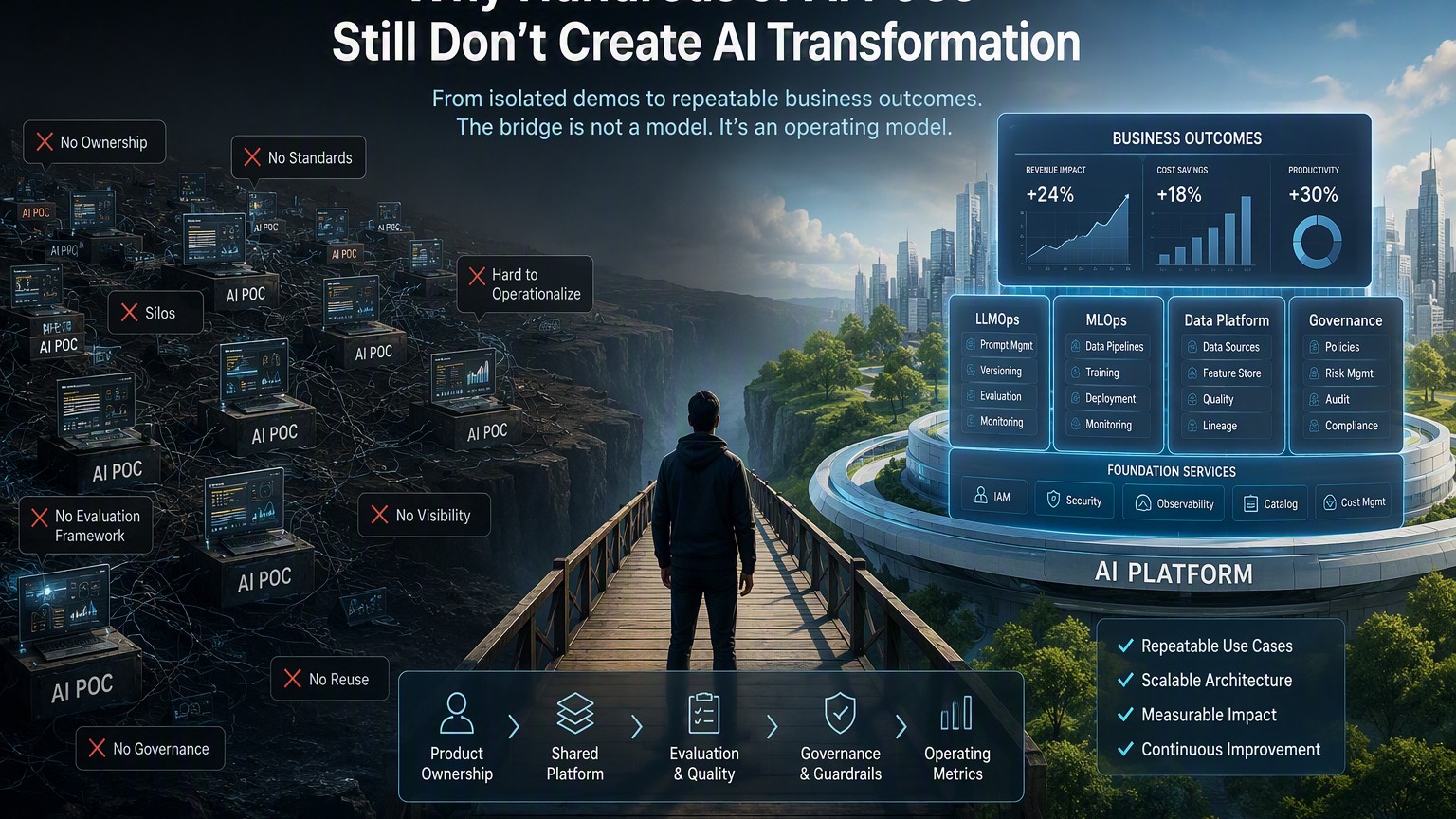
A successful AI demo can be built in days. It can summarize a document, classify a support ticket, answer questions over a knowledge base, or predict which asset may fail next.
That speed creates a dangerous illusion: if one proof of concept is useful, launching hundreds should produce transformation.
It rarely does.
Most proofs of concept optimize for technical possibility under controlled conditions. Transformation requires something different: reliable business outcomes across real users, changing data, production constraints, regulatory obligations, and existing workflows. The gap is not primarily about model quality. It is about ownership, architecture, economics, governance, and organizational design.
An enterprise can therefore have an impressive AI portfolio while creating little durable value. The experiments remain isolated, teams repeatedly solve the same infrastructure problems, and successful demos fail when exposed to production traffic.
Moving beyond this pattern requires treating AI not as a collection of experiments, but as a capability for repeatedly changing how the business operates.
PoC volume is a misleading progress metric
Counting proofs of concept measures activity, not transformation.
A PoC usually answers a narrow question: Can this model perform this task on a selected dataset? That is useful, but it leaves many harder questions unanswered:
- Will users change their behavior or continue using the existing process?
- Does the system work on incomplete, stale, adversarial, or unusual inputs?
- Can the organization legally and safely use the required data?
- Is there a fallback when the model is unavailable or uncertain?
- Can quality be measured after deployment?
- Does the outcome justify inference, integration, support, and review costs?
- Who owns failures six months later?
These are not implementation details. They determine whether an experiment can become part of an operating business.
A portfolio of 200 PoCs may represent 200 independently funded demonstrations, each with its own data extraction, prompt strategy, evaluation spreadsheet, and security review. Nothing compounds. The 201st project starts almost from zero.
Transformation begins when each delivery makes the next one cheaper, safer, or faster.
Why the prototype-to-production funnel collapses
The typical enterprise funnel loses projects at several distinct boundaries:
flowchart LR
    A[Idea] --> B[Prototype]
    B --> C[Validated use case]
    C --> D[Production service]
    D --> E[Workflow adoption]
    E --> F[Measured business outcome]

    B -. weak data .-> X[Stopped]
    C -. no owner .-> X
    D -. unsafe or costly .-> X
    E -. low adoption .-> X
Organizations often invest heavily in the first arrow and assume the rest will follow. They do not, because every transition requires a different kind of evidence.
The PoC was designed to demonstrate, not survive
Prototype teams make reasonable shortcuts to answer a question quickly:
- manually cleaned evaluation data;
- hard-coded credentials or local configuration;
- a single model and provider;
- no load, latency, or failure testing;
- permissive access to source documents;
- human review by project experts;
- quality judgments based on memorable examples.
Those shortcuts are appropriate when they are explicit and temporary. Problems arise when leaders interpret a polished interface as evidence that the system is nearly production-ready.
A chat interface connected to ten curated documents is not a production knowledge assistant. The production system also needs identity-aware retrieval, document lifecycle handling, traceability, injection resistance, monitoring, feedback processing, incident response, and an ownership model.
The use case has no accountable product owner
Many PoCs are sponsored by an innovation function but depend on an operational team to create value. The innovation team can prove that ticket routing is feasible; only the support organization can redesign queues, retrain agents, modify service metrics, and accept responsibility for incorrect routing.
Without an owner who controls the affected workflow and budget, the PoC becomes an orphan. Engineering is asked to productionize it, but no one has authority to define acceptable errors or change the process around it.
An AI use case needs a product owner accountable for both sides of the equation:
- System performance: quality, latency, reliability, security, and cost.
- Business performance: adoption, cycle time, revenue, loss avoidance, or another operational result.
If these are owned separately, teams can declare technical success while the business outcome remains unchanged.
Evaluation stops at model quality
Model-centric metrics are necessary but insufficient. A classifier with strong offline accuracy may still harm operations if its errors are concentrated in high-risk cases. A retrieval system may score well on a benchmark but fail because users cannot tell whether an answer is current.
Production evaluation needs multiple layers:
- Component metrics: retrieval relevance, classification precision, groundedness, or tool-call correctness.
- System metrics: end-to-end task completion, latency, availability, and cost per task.
- Workflow metrics: escalation rate, review time, rework, and user override rate.
- Business metrics: resolution time, conversion, loss rate, throughput, or customer satisfaction.
- Risk metrics: policy violations, sensitive-data exposure, harmful actions, and severity-weighted errors.
The metric hierarchy prevents a team from optimizing a model while degrading the surrounding operation.
Every team rebuilds the same undifferentiated machinery
When PoCs are isolated, each team selects its own orchestration library, logging format, model access pattern, vector store, prompt registry, and evaluation method. This maximizes local freedom but creates enterprise-wide duplication.
The result is a set of incompatible prototypes rather than a platform. Security reviews cannot be reused, telemetry cannot be compared, and moving a use case between models requires substantial rework.
Standardization does not mean forcing every workload through one model or framework. It means establishing stable seams around common concerns: identity, model access, policy enforcement, observability, evaluation, deployment, and cost attribution.
Start with an outcome contract, not a demo brief
Before implementation, define a compact contract connecting the use case to an operational decision. It should be specific enough to stop low-value work early.
use_case: support-ticket-routing
owner: customer-operations
user: queue-manager
business_outcome:
  metric: median-time-to-first-assignment
  target_direction: decrease
baseline_required: true
system_boundary:
  input: new support ticket
  output: suggested queue and confidence
human_authority: queue manager may override any suggestion
quality:
  primary_metric: precision_by_queue
  critical_error: route security incidents outside security queue
operations:
  latency_budget_ms: 1500
  fallback: existing rule-based router
  audit_retention_days: 90
cost:
  unit: processed_ticket
  maximum_defined_by_owner: true
This is not a universal schema. It illustrates the decisions that must be explicit.
The tradeoff is deliberate: requiring this information slows idea intake, but it prevents teams from spending weeks on use cases with no baseline, no owner, or no acceptable failure policy. Unknown values are acceptable during discovery; absent accountability is not.
A useful outcome contract should answer four questions:
- What decision or workflow will change?
- How will improvement be measured against the current baseline?
- Which errors are unacceptable, and who accepts residual risk?
- What happens when the AI system is uncertain or unavailable?
Replace the PoC pipeline with evidence-based stage gates
A PoC should not automatically graduate because stakeholders liked the demo. Progress should depend on evidence appropriate to each stage.
1. Discovery: prove the problem is worth solving
Confirm that the workflow occurs often enough, costs enough, and can actually be changed. Establish the baseline before introducing AI. A ten-minute reduction is meaningless if the original process takes eleven minutes only twice a month.
Also test whether simpler automation is sufficient. Deterministic rules, search, templates, and conventional statistical models are often cheaper to operate and easier to audit. Choosing them is not a failure to innovate.
2. Feasibility: prove performance on representative data
Use data sampled from the intended operating environment, including difficult cases. Separate development and evaluation sets, define error categories, and compare against both the current process and a simple baseline.
For generative systems, avoid relying solely on subjective ratings. Create task-specific checks where possible: citation support, required-field presence, valid structured output, tool-call correctness, and policy compliance. Human evaluation remains important, but reviewers need a rubric and blind comparisons to reduce bias.
3. Pilot: prove the workflow with controlled exposure
Integrate with real identity, data, and user interfaces. Limit scope by team, geography, request type, or traffic percentage. Instrument overrides, abandonment, downstream corrections, and fallback use.
Human review is valuable during this stage, but its cost must be measured. A system that saves five minutes of drafting while adding eight minutes of mandatory review does not improve throughput.
4. Production: prove operability and economics
Production readiness includes service-level objectives, capacity planning, access controls, incident procedures, data retention, model-change testing, and cost monitoring. Teams should know how to disable the AI path without disabling the business process.
5. Scale: prove repeatability
Scaling is not merely sending more traffic to one application. It means demonstrating that reusable components, controls, and delivery practices accelerate the next use case.
A sensible stage gate can stop, revise, or advance a project. Stopping is a healthy result when evidence no longer supports investment.
Build a paved road, not a central bottleneck
A shared AI platform should make the safe path the easy path while leaving product teams accountable for use-case behavior.
flowchart TB
    U[Business workflow] --> S[AI application service]
    S --> G[Model gateway]
    S --> R[Retrieval and tools]
    S --> E[Evaluation hooks]

    G --> M1[Approved model endpoint]
    G --> M2[Alternative model endpoint]
    R --> D[Authorized enterprise data]

    S --> O[Logs metrics and traces]
    G --> O
    R --> O
    E --> Q[Quality and risk dashboards]
    O --> Q
The platform layer can provide:
- authenticated access to approved model endpoints;
- rate limits, quotas, and cost attribution;
- standardized traces with sensitive-data controls;
- deployment templates and runtime policies;
- evaluation harnesses and versioned test sets;
- connectors that preserve source permissions;
- model and prompt change records;
- common fallback and circuit-breaker patterns.
The application team still owns prompts, domain logic, user experience, task-level evaluation, and business outcomes.
This boundary matters. A fully centralized team becomes a ticket queue and lacks domain context. Fully decentralized teams duplicate infrastructure and interpret risk inconsistently. A federated model—shared enablement with embedded product ownership—usually provides a better balance.
Design for changing models and imperfect outputs
AI systems introduce dependencies that change independently: model versions, provider behavior, retrieval corpora, prompts, tools, and policies. Production architecture should make those changes observable and reversible.
For each request, record enough metadata to reproduce and diagnose behavior where policy permits:
{
  "use_case": "support-ticket-routing",
  "application_version": "2025.03.2",
  "model_alias": "routing-default",
  "prompt_version": "route-v7",
  "retrieval_snapshot": null,
  "decision": "security",
  "confidence_band": "high",
  "fallback_used": false,
  "latency_ms": 412,
  "input_tokens": 286,
  "output_tokens": 18
}
An alias is preferable to scattering provider-specific model identifiers throughout application code. It enables controlled replacement and rollback. However, abstraction has limits: models differ in context handling, structured output reliability, latency, and tool semantics. A gateway should normalize access and policy, not pretend all models behave identically.
Similarly, confidence should not be treated as a universally calibrated probability. It can be a useful routing signal only after validation for the specific task. High-impact decisions may require deterministic checks or human approval regardless of the model's self-reported certainty.
Make adoption part of the engineering scope
A technically correct system creates no value if people route around it.
Adoption failures often come from poor workflow placement rather than resistance to AI. Users may need to copy data between systems, wait too long for a response, verify opaque output, or accept suggestions that increase their personal risk while benefiting another department.
Engineering and product teams should observe the actual workflow and design for minimal disruption:
- place assistance at the point of decision;
- show evidence when verification matters;
- make correction easier than starting over;
- preserve user authority for ambiguous or high-impact cases;
- capture feedback without turning users into unpaid annotators;
- explain fallback behavior and known boundaries.
User overrides are especially valuable signals. They may reveal model errors, policy disagreements, outdated source data, or a changing workflow. Treating every override as model failure can lead to the wrong fix; teams need both telemetry and qualitative investigation.
Manage AI as a portfolio of products
Once stage gates and platform capabilities exist, leadership can manage investment based on evidence rather than enthusiasm.
A useful portfolio view tracks:
- time from discovery to controlled pilot;
- percentage of pilots reaching sustained production use;
- adoption and task completion by cohort;
- business impact against a recorded baseline;
- total cost per successful task, including human review;
- incident and severity-weighted error rates;
- reuse of approved platform components;
- time required to evaluate and roll out a model change.
The goal is not to maximize the production conversion rate. If every idea ships, discovery is probably too conservative or stage gates are weak. The goal is to stop weak ideas cheaply and scale strong ones predictably.
Funding should reflect this uncertainty. Small discovery budgets can be released quickly, while larger production investment depends on evidence. After launch, funding should continue only while the product demonstrates adoption, acceptable risk, and business value.
What transformation actually looks like
AI transformation is not the moment an enterprise deploys a chatbot. It is the point at which the organization can repeatedly identify suitable workflows, test them honestly, productionize them safely, measure outcomes, and improve them over time.
That capability has recognizable characteristics:
- business and technical owners share accountability;
- experiments begin with measurable outcome contracts;
- representative evaluation precedes broad exposure;
- production systems include fallbacks, observability, and change control;
- common platform services reduce repeated engineering work;
- governance is embedded in delivery rather than added at the end;
- portfolio decisions use operational and economic evidence;
- unsuccessful ideas are stopped without being disguised as wins.
Conclusion
Hundreds of PoCs do not create transformation when each one is an isolated demonstration. They create transformation only when experimentation feeds a repeatable operating system for delivery.
The practical shift is from asking, “Can the model do this?” to asking, “Can we operate this capability safely, economically, and measurably inside a real workflow?”
Organizations that make that shift may run fewer demos. But the experiments they do run produce stronger evidence, reusable infrastructure, clearer ownership, and a credible path from technical possibility to sustained business outcomes.