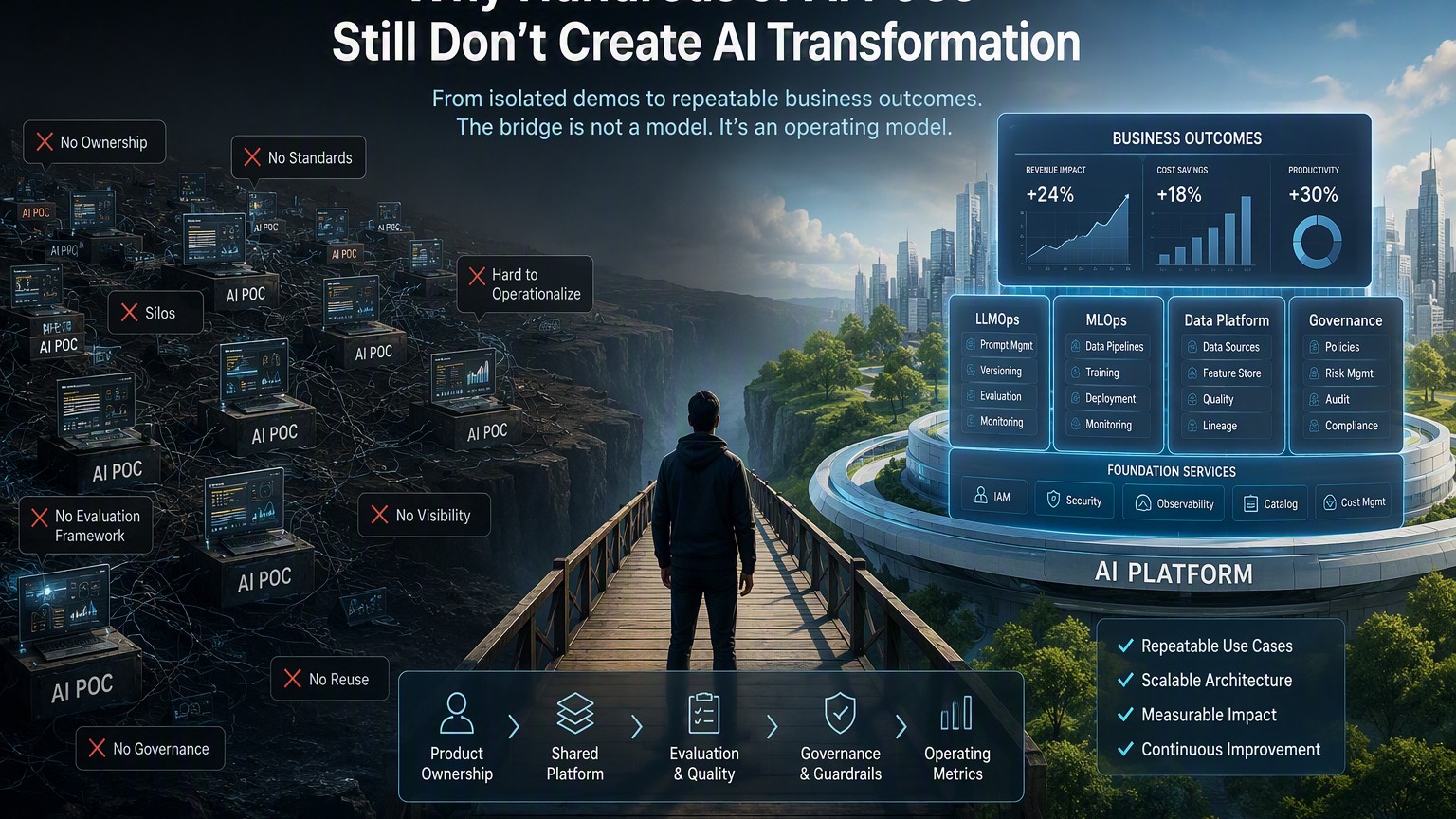
Enterprise Platform Architecture: A Secure, Scalable, and Governable Foundation
A platform architecture is not simply a larger version of an application architecture. It defines the shared foundation on which many products, teams, integrations, data flows, and operating models can evolve safely and independently.
That distinction becomes increasingly important as an enterprise grows. The same technology ecosystem may need to support customer-facing digital products, B2B services, partner integrations, internal applications, data platforms, automation, and AI workloads. The platform must enable reuse without tightly coupling every product together. It must scale without requiring infrastructure teams to manually operate every component, and it must provide security, governance, observability, resilience, and cost controls as built-in capabilities rather than project-by-project additions.
The goal is not maximum technical sophistication. The goal is a secure, observable, resilient, cost-conscious, and evolvable enterprise foundation with clear boundaries and reusable standards that engineering teams can adopt repeatedly.
1. Start with Architectural Principles
Technology choices will change. Architectural principles should remain stable enough to guide those changes.
A modern enterprise platform should adopt the following principles:
- One foundation, multiple trust boundaries. Share infrastructure capabilities, deployment patterns, and engineering standards while isolating workloads according to business risk, regulatory requirements, and customer needs.
- Domain ownership over shared databases. Teams own business capabilities, data, and contracts. Shared infrastructure does not imply shared database tables.
- Managed services by default. Prefer managed compute, databases, messaging, identity, security, and observability unless a measured requirement justifies operating the technology directly.
- API-first and event-enabled integration. Use synchronous APIs for immediate interactions and asynchronous events for workflows where temporal decoupling provides value.
- Data is explicitly classified. Confidential, restricted, regulated, and public information should have defined handling requirements throughout its lifecycle.
- Zero Trust as a design assumption. Network location alone does not establish trust. Every user, workload, device, and service interaction should be authenticated and appropriately authorized.
- Security controls are platform capabilities. Identity, auditability, encryption, secrets management, vulnerability controls, and policy enforcement should be built into the paved road.
- Automation over manual operations. Infrastructure, policy, deployments, recovery, and routine operational activities should be automated wherever practical.
- Observability by default. Logs, metrics, traces, service health, and business telemetry should be available consistently across workloads.
- Evolution before prediction. Build components that can be separated, scaled, or replaced later instead of deploying the most complex topology on day one.
- Cost is an architectural quality. Every major component should have an owner, measurable consumption, scaling policy, and lifecycle strategy.
- Failure is expected. Architecture should assume dependencies, zones, services, deployments, and integrations can fail and provide defined recovery behavior.
These principles provide a test for architecture decisions. A new service, database, platform component, or vendor should have a clear owner, purpose, security classification, operational model, lifecycle, and reason to exist.
2. Use a Layered Platform with Bounded Domains
The platform should separate experience channels, access controls, business capabilities, shared platform services, integration, data, and intelligent workloads.
flowchart TB
    WEB[Customer Web and Mobile] --> EDGE[Edge / WAF / API Access]
    B2B[B2B and Partner Channels] --> EDGE
    STAFF[Internal Applications] --> EDGE
    EXT[External Systems] --> EDGE

    EDGE --> DOMAINS[Domain Services]
    DOMAINS --> EVENTS[Event and Integration Backbone]
    DOMAINS --> DATA[Operational Data Stores]

    EVENTS --> DATAP[Enterprise Data Platform]
    EVENTS --> AUTO[Automation and Intelligent Services]
    DATAP --> AUTO
    AUTO --> DOMAINS

    PLATFORM[Platform Engineering Capabilities] --> EDGE
    PLATFORM --> DOMAINS
    PLATFORM --> EVENTS
    PLATFORM --> DATAP
    PLATFORM --> AUTO

    SEC[Identity / Security / Policy / Secrets] --> PLATFORM
    OBS[Observability / SRE / FinOps] --> PLATFORM
This separation creates architectural boundaries without forcing every boundary to become a separately deployed microservice.
3. Experience and Access Layer
Customer applications, employee applications, B2B portals, APIs, partner integrations, and machine-to-machine interfaces are different experiences even when they consume the same underlying business capabilities.
A controlled access layer should provide capabilities such as:
- TLS termination and certificate management
- web application firewall protection
- DDoS protection where required
- authentication and coarse-grained authorization
- API routing and version management
- rate limiting and throttling
- partner- and tenant-specific quotas
- request correlation identifiers
- standardized access logging
- bot and abuse protection
- controlled exposure of public versus private APIs
An API gateway should enforce access and traffic policies, but it should not become the location for core business workflows. Business authorization decisions that depend on domain state belong within the appropriate domain service or a dedicated authorization/policy capability.
4. Organize Business Capabilities into Domains
Services should align with durable business capabilities rather than technical layers.
Examples might include:
- customer and account management
- organization and partner management
- product or catalog management
- orders or transactions
- billing and payments
- document management
- workflow and case management
- notifications
- reporting
- consent and preference management
Each domain should own its operational behavior and data. Other domains consume a documented API or event rather than reading another domain's database directly.
This prevents a convenient shared schema from becoming the enterprise's primary coupling mechanism.
Modular monoliths are valid
Domain-driven architecture does not require dozens or hundreds of microservices.
For many organizations, a modular monolith is an effective starting point. Strong code and schema boundaries can exist inside a shared deployment unit. A module should be extracted into an independently deployed service only when there is a concrete reason, such as:
- independent scaling requirements
- different availability requirements
- stronger security isolation
- different release cadence
- independent team ownership
- technology-specific workload requirements
- regulatory or contractual isolation
Microservices should be an outcome of meaningful boundaries, not an architectural objective by themselves.
5. Build Platform Engineering as a Product
A platform team should provide reusable engineering capabilities rather than becoming a centralized infrastructure ticket queue.
The enterprise platform should normally provide:
- cloud account/subscription/project provisioning
- network and connectivity patterns
- DNS and certificate automation
- workload identity
- standardized CI/CD pipelines
- infrastructure-as-code modules
- artifact and container registries
- secrets and cryptographic key management
- API management patterns
- event and messaging infrastructure
- centralized logs, metrics, and traces
- vulnerability and dependency scanning
- backup and recovery automation
- policy-as-code controls
- environment provisioning
- service templates and golden paths
- software supply-chain controls
- developer self-service capabilities
Product teams should remain responsible for their workloads in production. The platform team owns the paved road, automation, shared capabilities, and platform reliability.
A successful internal platform makes the secure and supportable approach easier than building a custom alternative.
6. Support Enterprise and B2B Workloads Through Explicit Tenancy
Enterprise platforms frequently need to support individuals, organizations, partners, subsidiaries, business units, and machine identities simultaneously.
Represent these concepts explicitly:
- Subject: the person or workload making a request
- Organization: the enterprise, customer, partner, or tenant
- Membership: the subject's relationship and role within an organization
- Resource owner: the entity controlling a resource
- Role: what actions a subject may perform
- Purpose: why access or processing is permitted
- Policy: contextual rules governing access
Every tenant-scoped record should carry an immutable tenant or organization identifier. Automated authorization tests should verify cross-tenant isolation.
Use tiered isolation instead of assuming one universal model:
- shared compute and shared databases for standard workloads
- separate schemas or databases for stronger isolation
- dedicated encryption keys for higher-risk tenants
- dedicated infrastructure or deployment cells for contractual, regulatory, performance, or security requirements
This preserves platform reuse while allowing isolation to increase according to risk.
7. Treat Sensitive and Regulated Data as Explicit Data Domains
Sensitive information should never become ordinary application attributes that are copied freely between services, logs, analytics platforms, support systems, and external providers.
Classify enterprise data into defined levels such as:
- Public
- Internal
- Confidential
- Restricted
- Regulated
The exact classification model should align with organizational and regulatory requirements.
Restricted data should use stronger controls and, where appropriate, dedicated storage boundaries. Downstream systems should prefer opaque identifiers or references rather than unnecessary replication of sensitive payloads.
sequenceDiagram
    participant U as User / Partner / Workload
    participant A as Application
    participant P as Authorization Policy
    participant D as Restricted Data Store
    participant L as Audit Platform

    U->>A: Request protected resource
    A->>P: Subject + tenant + purpose + resource
    P-->>A: Allow / Deny
    A->>L: Record authorization decision
    A->>D: Access with workload identity
    D-->>A: Protected result
    A->>L: Record data access
    A-->>U: Minimum necessary response
Important controls include:
- encryption in transit and at rest
- centrally managed cryptographic keys
- workload identities instead of static credentials
- production and non-production data separation
- data masking and tokenization where appropriate
- prohibition of restricted values in logs and traces
- administrative interface redaction
- immutable or tamper-resistant audit trails
- retention and deletion automation
- backup lifecycle controls
- controlled break-glass access
- periodic access reviews
- data-loss prevention controls
- cross-border and third-party data-transfer governance where applicable
Data governance should cover the entire lifecycle: collection, processing, storage, sharing, archival, backup, and deletion.
8. Separate Operational Data from the Enterprise Data Platform
Transactional applications and analytical workloads have different requirements.
Operational databases should optimize for business transactions, consistency, and application availability. Analytics platforms should support historical analysis, aggregation, reporting, forecasting, and large-scale processing without placing uncontrolled workloads on production databases.
A typical pattern is:
flowchart LR
    APP[Domain Applications] --> ODS[(Operational Stores)]
    APP --> EVT[Events / CDC]
    ODS --> CDC[Controlled CDC]
    CDC --> INGEST[Data Ingestion]
    EVT --> INGEST
    INGEST --> RAW[Raw / Landing Zone]
    RAW --> CURATED[Curated Data Products]
    CURATED --> BI[BI and Reporting]
    CURATED --> DS[Data Science / Intelligent Workloads]
Important principles include:
- production applications remain the systems of record
- analytical consumers do not directly depend on transactional schemas
- datasets have owners and documented lineage
- sensitive fields are minimized, masked, or tokenized where possible
- retention policies differ by data purpose
- data contracts protect consumers from uncontrolled schema changes
- data quality is measurable and monitored
Treat important analytical datasets as data products with owners, contracts, quality expectations, and lifecycle management.
9. Build a Governed Automation and Intelligent Workload Layer
Modern enterprises increasingly run automation, predictive models, recommendation systems, document processing, search, and AI-assisted workflows. These workloads have different execution characteristics from transactional APIs but should still inherit the platform's identity, security, governance, observability, and delivery controls.
Separate the lifecycle into capabilities such as:
- Governed data preparation — approved, versioned datasets with lineage and access policies.
- Experimentation and development — isolated and reproducible execution environments.
- Artifact and model management — versioned artifacts, evaluations, ownership, and approval state.
- Controlled deployment — repeatable promotion through environments.
- Runtime execution — online, asynchronous, or batch processing according to business requirements.
- Monitoring and governance — performance, quality, cost, security, and operational monitoring.
These workloads should consume curated data instead of directly querying production databases whenever practical.
External AI or SaaS providers should be treated as third-party data processors. Confidential or personal information should not be sent externally without appropriate security, privacy, retention, contractual, and data-transfer review.
10. Use API and Event Integration Deliberately
Not every interaction should be synchronous and not every interaction should be event-driven.
Use synchronous APIs when:
- the caller needs an immediate result
- the operation is interactive
- transactional feedback is required
- the dependency is intentionally direct
Use asynchronous messaging or events when:
- processing can happen later
- multiple consumers need the same business event
- workloads have different scaling characteristics
- temporary consumer outages should not stop the producer
- long-running workflows are involved
Typical event-driven workflows include transaction completion, document processing, notifications, audit export, integration synchronization, and analytical ingestion.
Consumers should assume at-least-once delivery and therefore be idempotent.
A transactional outbox pattern can prevent the dual-write problem between an operational database and event broker:
BEGIN;
UPDATE orders
SET status = 'completed'
WHERE id = :order_id;

INSERT INTO outbox (
    event_id,
    event_type,
    aggregate_id,
    payload
)
VALUES (
    :event_id,
    'OrderCompleted',
    :order_id,
    :payload
);
COMMIT;
A relay publishes committed outbox entries to the event platform. Consumers either track processed event identifiers or use naturally idempotent operations.
Event-driven architecture adds operational complexity and should be used where it creates meaningful decoupling—not for every internal function call.
11. Scale Through Repeatable Deployment Cells
A platform does not need global active-active architecture from the beginning.
Start with one appropriately resilient deployment footprint and design it as a repeatable cell containing the resources required to serve a defined group of workloads or tenants.
A cell may contain:
- application compute
- operational databases
- messaging
- caches
- storage
- networking
- secrets and workload identity integrations
- observability integrations
flowchart TB
    CP[Platform Control Plane]

    CP --> C1[Cell A]
    CP --> C2[Cell B]
    CP --> C3[Cell C]

    C1 --> T1[Tenant / Workload Group 1]
    C2 --> T2[Tenant / Workload Group 2]
    C3 --> T3[Tenant / Workload Group 3]
Keep the control plane separate from the data plane.
The control plane can manage:
- tenant or workload placement
- configuration and policy
- deployment metadata
- environment provisioning
- release orchestration
- platform administration
The data plane serves production traffic and processes business data.
Cell-based architecture improves failure containment and creates a practical path for regional expansion, customer isolation, data residency, or large-scale growth.
12. Design for Resilience and Disaster Recovery
Availability is not created by deploying everything across multiple regions. It starts with understanding business impact and defining appropriate recovery objectives.
For each domain define:
- SLO: expected service reliability
- RTO: maximum acceptable recovery time
- RPO: maximum acceptable data loss
- dependency criticality
- degradation behavior
- backup requirements
- failover strategy
Different workloads require different resilience levels. A financial transaction ledger and a rebuildable cache should not receive identical recovery architecture.
Important patterns include:
- multi-zone deployment for critical services
- automated database backups
- point-in-time recovery where appropriate
- tested infrastructure recreation
- queue-based buffering during downstream failures
- retries with exponential backoff and jitter
- circuit breakers and timeouts
- graceful degradation
- dependency health monitoring
- regular disaster-recovery exercises
A backup is only useful if restoration has been tested.
13. Make Security Continuously Verifiable
Security should be enforced through architecture, automation, and policy rather than relying primarily on documentation and manual review.
Identity
Use:
- centralized enterprise identity
- phishing-resistant MFA for privileged access
- role-based access control
- just-in-time privileged access where possible
- workload identity and short-lived credentials
- periodic entitlement reviews
Infrastructure policy
Policy-as-code should detect or prevent conditions such as:
- public storage without an approved exception
- unrestricted network ingress
- databases without encryption
- workloads using unmanaged secrets
- missing resource ownership metadata
- missing data classification
- unsupported regions
- excessive administrative privileges
Exceptions should contain:
- owner
- business justification
- risk assessment
- compensating controls
- approver
- expiration date
Software supply chain
Enterprise platforms should also protect the path from source code to production through:
- protected source repositories
- mandatory review policies
- dependency scanning
- secret scanning
- static and dynamic security testing where appropriate
- software bill of materials generation
- signed build artifacts
- trusted artifact registries
- immutable deployment artifacts
- provenance and attestation
- controlled third-party dependencies
Production should deploy the artifact that was reviewed and tested—not rebuild an unverified variant later in the release process.
14. Make Observability a Platform Standard
Every production workload should expose enough information to understand health without engineers manually inspecting individual machines or containers.
The platform should standardize:
- structured application logs
- infrastructure metrics
- distributed traces
- correlation IDs
- service dashboards
- SLO and error-budget reporting
- alert routing
- synthetic monitoring where appropriate
- dependency telemetry
- business transaction metrics
Observability should answer four basic questions quickly:
- Is the service available?
- Is it performing correctly?
- What changed?
- What is the user or business impact?
Avoid treating logging as unlimited storage. Define retention according to operational, security, legal, and cost requirements.
15. Integrate SRE into the Operating Model
Reliability should be shared between product, platform, and SRE functions.
Product teams own application behavior and service outcomes. Platform engineering owns shared capabilities and paved roads. SRE establishes and improves reliability practices across the environment.
SRE capabilities may include:
- SLO definition
- production readiness reviews
- incident management
- error-budget practices
- reliability automation
- capacity analysis
- resilience testing
- operational documentation
- post-incident reviews
- toil reduction
The objective is not to create another operations queue. It is to continuously improve the reliability and operability of the engineering system.
16. Build Cost Governance into the Architecture
Cost should be visible at the same level as reliability and security.
Every major platform component should have:
- an owner
- allocation metadata
- budget visibility
- scaling policy
- retention policy
- lifecycle strategy
Useful controls include:
- mandatory cost-allocation tags or labels
- budgets and anomaly alerts by product and environment
- automatic expiration of preview environments
- lifecycle policies for logs, artifacts, backups, and intermediate data
- scale-to-zero development workloads where practical
- scheduled identification of idle resources
- rightsizing reviews
- reserved capacity or commitment analysis for predictable workloads
- unit economics such as cost per transaction, tenant, customer, workflow, or API call
Avoid adopting operationally expensive platforms merely because they are popular. Kubernetes, for example, is valuable for certain workload portfolios, but it creates a permanent operational surface. Managed application and job runtimes may provide a better cost and operational profile for smaller or simpler estates.
17. Provide Developer Self-Service with Guardrails
Platform engineering should reduce cognitive load for development teams.
A developer should be able to create a compliant service without first becoming an expert in networking, IAM, observability, container security, certificates, or infrastructure provisioning.
A mature paved road can provide:
Service Template
      |
      v
Repository + Ownership Metadata
      |
      v
CI Security and Quality Checks
      |
      v
Infrastructure Provisioning
      |
      v
Deployment
      |
      +--> Identity / Secrets
      +--> Observability
      +--> API / Networking
      +--> Policy
      +--> Cost Metadata
      |
      v
Production Readiness
Self-service does not mean unrestricted infrastructure creation. It means approved capabilities can be consumed through automated interfaces with policy embedded into the workflow.
18. Establish Standards Without Blocking Delivery
Architecture governance is effective when standards are executable and easy to adopt.
Maintain a concise engineering handbook covering:
- approved runtime and infrastructure patterns
- API and event contract conventions
- identity and authorization requirements
- tenancy standards
- data classification and retention
- encryption and key management
- observability minimums
- service-level objectives
- dependency and vulnerability management
- software supply-chain requirements
- resilience and disaster recovery
- incident ownership
- production readiness
- third-party integration requirements
Provide reusable templates that implement these standards:
- service skeletons
- infrastructure modules
- deployment pipelines
- dashboards
- alert configurations
- policy templates
- threat-model worksheets
- architecture decision record templates
- production-readiness checklists
Governance should be proportional to risk. A low-risk internal application should not require the same review process as a mission-critical system processing restricted data.
The objective is consistent treatment of consequential risk, not centralized approval of every engineering decision.
19. Define Clear Ownership and Responsibility
Architecture frequently fails because ownership is unclear rather than because the technology is wrong.
Every production capability should have defined ownership for:
| Area | Primary Responsibility |
|---|---|
| Business capability | Product / Domain Team |
| Application code | Product / Domain Team |
| Shared platform services | Platform Engineering |
| Enterprise architecture standards | Architecture |
| Reliability practices | Product + Platform + SRE |
| Security standards | Security + Platform + Product |
| Data governance | Data Owners + Security + Platform |
| Cloud cost optimization | Engineering + FinOps + Product |
| Incident response | Service Owner with SRE/Platform support |
The exact organization model can differ, but ambiguous responsibility should not.
20. Introduce Architecture Fitness Functions
Architecture standards should be measurable where possible.
Instead of stating that systems "must be secure and resilient," define automated checks that continuously verify architectural expectations.
Examples include:
- percentage of workloads using workload identity
- percentage of services with defined SLOs
- percentage of production resources with owners
- public endpoints without approved exceptions
- databases without tested restore procedures
- services missing dashboards or alerts
- unsupported runtime versions
- unresolved critical vulnerabilities
- infrastructure created outside IaC
- workloads missing cost allocation metadata
- cross-domain database access violations
These architecture fitness functions turn architecture from a periodic review activity into a continuously evaluated property of the engineering estate.
21. Measure Platform Success
A platform should be measured by the outcomes it creates, not the number of technologies it operates.
Useful indicators include:
Developer experience
- time required to create a production-ready service
- deployment frequency
- lead time for changes
- percentage of services using standard templates
- developer satisfaction with platform capabilities
Reliability
- SLO attainment
- mean time to detect
- mean time to restore
- change failure rate
- recurring incident rate
Security
- privileged access exposure
- policy compliance rate
- critical vulnerability remediation time
- percentage of workloads using managed identity
- exception aging
Cost
- infrastructure cost per product or transaction
- idle resource percentage
- environment utilization
- observability cost as a percentage of platform spend
Platform adoption
- paved-road adoption
- self-service versus manual requests
- infrastructure module reuse
- time spent on platform-related support tickets
A platform that becomes technically sophisticated while slowing delivery has failed its primary purpose.
22. Evolve the Platform in Stages
Do not attempt to build the final-state enterprise platform immediately.
Stage 1 — Foundation
Establish:
- identity
- network boundaries
- infrastructure as code
- CI/CD
- secrets management
- basic observability
- backup standards
- resource ownership and tagging
Stage 2 — Paved Road
Introduce:
- service templates
- reusable infrastructure modules
- automated environment provisioning
- standardized dashboards and alerts
- API and event standards
- security policy automation
Stage 3 — Scale and Governance
Add:
- explicit tenancy models
- stronger data governance
- data platform capabilities
- SLO management
- FinOps automation
- architecture fitness functions
- software supply-chain controls
Stage 4 — Advanced Enterprise Capabilities
Introduce where justified:
- deployment cells
- regional expansion
- advanced workload isolation
- automated disaster recovery
- intelligent workload platforms
- sophisticated policy engines
- enterprise-wide developer portals
Each stage should solve observed organizational problems rather than satisfy an abstract maturity model.
Reference Enterprise Platform View
flowchart TB
    USERS[Customers / Employees / Partners / Systems]

    USERS --> EDGE[Edge / WAF / API Gateway]

    subgraph EXPERIENCE[Experience Layer]
        WEB[Web]
        MOBILE[Mobile]
        PORTAL[B2B / Partner Portal]
        INTERNAL[Internal Apps]
    end

    EXPERIENCE --> EDGE
    EDGE --> SERVICES

    subgraph SERVICES[Business Domain Layer]
        D1[Domain A]
        D2[Domain B]
        D3[Domain C]
        WF[Workflow Services]
    end

    SERVICES --> INTEGRATION

    subgraph INTEGRATION[Integration Layer]
        EVENTS[Event Backbone]
        API[Internal APIs]
        CONNECT[Enterprise Connectors]
    end

    SERVICES --> OPDATA[(Operational Data)]
    INTEGRATION --> DATA

    subgraph DATA[Data and Intelligence Layer]
        LAKE[Enterprise Data Platform]
        BI[Analytics / BI]
        AUTO[Automation / Intelligent Workloads]
    end

    subgraph PLATFORM[Platform Engineering]
        CICD[CI/CD]
        IAC[Infrastructure as Code]
        ID[Workload Identity]
        SECRET[Secrets / Keys]
        OBS[Observability]
        POLICY[Policy as Code]
        REG[Artifact Registry]
    end

    PLATFORM --> SERVICES
    PLATFORM --> INTEGRATION
    PLATFORM --> DATA

    subgraph GOVERNANCE[Enterprise Governance]
        SECURITY[Security]
        ARCH[Architecture]
        SRE[SRE]
        FINOPS[FinOps]
        DG[Data Governance]
    end

    GOVERNANCE --> PLATFORM
    GOVERNANCE --> SERVICES
    GOVERNANCE --> DATA
Conclusion
A durable enterprise platform shares engineering capabilities while preserving boundaries between domains, tenants, workloads, and sensitive data. It gives teams consistent paths for building, deploying, operating, and evolving software without requiring every team to independently solve identity, networking, security, observability, resilience, integration, and infrastructure automation.
The strongest platform architectures are not necessarily the ones with the most components. They are the ones with the clearest boundaries, ownership, automation, and evolutionary path.
Start with managed services, modular business boundaries, infrastructure as code, strong identity, observability, and a small paved road. Introduce dedicated services, event-driven workflows, deployment cells, advanced data platforms, additional regions, and stronger isolation only when scale, risk, reliability, or contractual requirements justify them.
The result is more than shared infrastructure. It is an enterprise engineering operating model encoded into technology—one that enables teams to move independently while maintaining security, reliability, governance, and cost discipline across the organization.