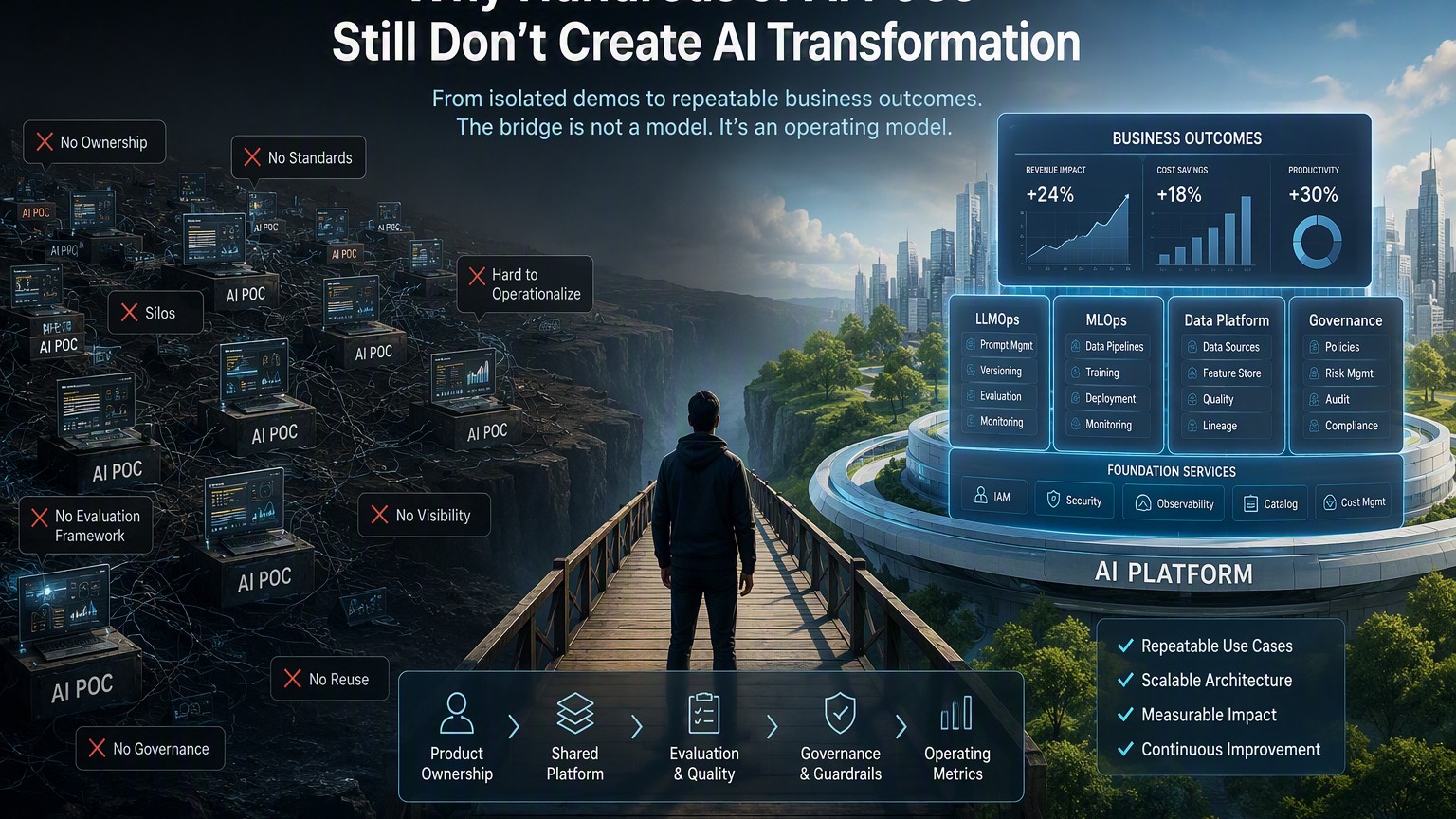
Building the Semantic Layer for Enterprise AI
Why shared meaning—not more embeddings—is becoming foundational infrastructure for knowledge graphs, RAG, and agentic systems.
Modern software rarely suffers from a lack of data. It suffers from a lack of shared meaning.
A customer may be represented as an account in a CRM, a policyholder in an insurance platform, a billing contact in an ERP system, and a claimant in a case-management database. Each application can be internally consistent while the organization as a whole remains unable to answer a basic question: Which records describe the same real-world party, and what is that party allowed to do?
Large language models do not automatically solve this problem. They can interpret text and generate plausible responses, but they still need reliable business context, relationships, definitions, and constraints. Without that foundation, retrieval systems return loosely related documents and autonomous agents make decisions using incompatible assumptions.
What enterprise AI needs is a semantic layer: a shared, machine-readable model of what business concepts mean, how they relate, and which constraints apply. An ontology is one of the strongest ways to implement that layer because it can define domain concepts, relationships, and—in richer models—logical axioms that allow software to derive new facts.
This distinction matters. The goal is not to make every enterprise application 'ontology-driven.' The goal is to give data platforms, knowledge graphs, RAG systems, and AI agents a common semantic foundation so that the same business term means the same thing wherever it is used.
From data structure to shared meaning
Taxonomies, database schemas, and ontologies solve related but different problems.
- A taxonomy organizes concepts into a hierarchy, such as
Poodlebeing a kind ofDog. - A database schema defines how data is stored, including tables, columns, types, keys, and constraints.
- An ontology models domain concepts, relationships, and logical semantics independently of a particular storage layout.
A relational schema might show that policy.claimant_id references party.id. It does not necessarily define whether every claimant is a customer, whether organizations may be claimants, or whether two source-system identifiers refer to the same party. Those meanings often remain buried in application code, documentation, and institutional knowledge.
An ontology makes such assumptions explicit and machine-readable. It might define:
Claimantas a role held by aPersonorOrganizationsubmittedClaimas a relationship between a claimant and a claiminsuredByas a relationship between an asset and a policyHighRiskClaimas a claim satisfying defined risk conditionscanApproveas a capability constrained by role and authority level
The objective is not to replace operational databases, APIs, or schemas. It is to place a semantic layer above them so that data from multiple systems can be interpreted consistently while the underlying systems remain optimized for their operational workloads.
How a semantic layer adds reasoning
One of the most powerful capabilities of a formally defined semantic layer is inference: deriving facts that were not stored explicitly. Ontologies expressed with standards such as RDFS and OWL can provide this behavior.
Suppose an ontology contains these class relationships:
Poodle is a subclass of Dog
Dog is a subclass of Mammal
Mammal is a subclass of WarmBloodedAnimal
If Fido is asserted to be a Poodle, a compatible reasoner can infer that Fido is also a Dog, a Mammal, and a WarmBloodedAnimal. Applications do not need to store every derived classification explicitly.
The same principle applies to business domains. If the ontology defines every CatastropheClaim as a HighPriorityClaim, and every high-priority claim as requiring expedited review, a system can infer the review requirement from the claim classification.
A small RDF and OWL example
Turtle is a compact syntax for representing RDF triples and OWL definitions:
@prefix ex: <https://example.com/insurance/> .
@prefix rdf: <http://www.w3.org/1999/02/22-rdf-syntax-ns#> .
@prefix rdfs: <http://www.w3.org/2000/01/rdf-schema#> .
@prefix owl: <http://www.w3.org/2002/07/owl#> .

ex:Poodle rdfs:subClassOf ex:Dog .
ex:Dog rdfs:subClassOf ex:Mammal .
ex:Mammal rdfs:subClassOf ex:WarmBloodedAnimal .

ex:Fido rdf:type ex:Poodle .

ex:submittedClaim a owl:ObjectProperty ;
    rdfs:domain ex:Claimant ;
    rdfs:range ex:Claim .

ex:ClaimantA ex:submittedClaim ex:ClaimB .
Each RDF statement is a subject-predicate-object triple. The final statement says that ClaimantA submitted ClaimB. The declared domain and range can also support inference: a reasoner may infer that ClaimantA is a Claimant and ClaimB is a Claim.
That behavior is useful, but it introduces an important modeling tradeoff. Domain and range declarations in RDFS are semantic implications, not input-validation rules. If bad data says that a repair shop submitted a claim, the reasoner may classify the repair shop as a claimant rather than reject the statement. Validation languages such as SHACL are commonly used when a system must verify that graph data conforms to required shapes.
Reasoning is not the same as validation
Production systems should distinguish three concerns:
- Inference derives facts from asserted facts and axioms.
- Validation checks whether data satisfies required structural or business constraints.
- Authorization determines whether an actor may read data or perform an action.
OWL generally follows an open-world assumption: missing information is treated as unknown, not false. Many business applications behave more like closed-world systems, where a missing approval means approval has not been granted. Combining ontology reasoning with validation, policy evaluation, and transactional controls is therefore safer than expecting one semantic model to perform every role.
Knowledge graphs and enterprise RAG
A knowledge graph represents entities and their relationships as a connected graph. The semantic layer supplies the meaning behind that graph: what entity types represent, how relationships should be interpreted, and—when formal ontology and reasoning are used—what additional facts can be inferred.
This is valuable when an enterprise has data spread across relational databases, documents, event streams, and APIs. Source-specific fields can be mapped to stable domain concepts such as Customer, Policy, Asset, Incident, and Claim. Entity resolution can then connect records that refer to the same real-world object while provenance records where each assertion originated.
Enterprise data platforms and graph-based RAG architectures increasingly use this pattern: map source data to stable business objects, connect those objects through explicit relationships, and expose the resulting context to applications and AI systems. Some platforms call this an ontology; others use terms such as semantic model, business object layer, or knowledge graph schema. The labels differ, but the architectural objective is similar: create a governed layer of shared meaning.
Implementations also differ in capability. A semantic layer should not automatically be assumed to provide reasoning, validation, access control, or workflow execution unless those functions are explicitly implemented.
graph LR
    A[Operational databases] --> D[Mapping and entity resolution]
    B[Documents] --> D
    C[Events and APIs] --> D
    O[Ontology] --> D
    D --> K[Enterprise knowledge graph]
    K --> R[Graph retrieval]
    B --> V[Text and vector index]
    V --> R
    R --> L[LLM with grounded context]
Why graph retrieval improves context
Basic RAG often divides documents into chunks, embeds them, and retrieves passages similar to a user's question. This works well for many document-centric tasks, but semantic similarity alone may not capture operational relationships.
Consider the question: “Which open claims may be affected by the supplier outage?” A text search may find outage reports and claims mentioning the supplier's name. A graph-enabled retrieval process can instead traverse explicit relationships:
Supplier -> supplies -> Component
Component -> installedIn -> Asset
Asset -> coveredBy -> Policy
Policy -> associatedWith -> OpenClaim
The retrieved context can include the relevant entities, relationship paths, source documents, and timestamps. The LLM then explains evidence selected through business relationships rather than guessing those relationships from nearby text.
This does not eliminate vector search. A practical enterprise RAG system often combines:
- vector retrieval for semantically relevant passages;
- graph traversal for entities, dependencies, and paths;
- structured queries for exact filters and aggregates;
- ontology terms for query interpretation and expansion;
- reranking and access-control filtering before generation.
For example, a query containing “vehicle” may be expanded to include ontology subclasses such as Truck and PassengerCar. Conversely, the ontology can prevent an ambiguous term such as “account” from combining financial accounts with user-login accounts.
Provenance and time must be first-class
A unified graph can create false confidence if every statement appears equally authoritative. Production knowledge graphs should attach or associate assertions with provenance, effective time, ingestion time, confidence, and ownership where appropriate.
“Supplier A provides Component B” may have been true last quarter but not today. Similarly, two systems may disagree about a customer's address. The ontology defines the meaning of the relationship; governance rules determine which source wins for a particular use case.
A semantic contract for agentic systems
As software moves toward agent-based architectures, semantic inconsistency becomes an execution risk.
Imagine an underwriting agent and a claims-routing agent both using a field named RiskScore. One interprets it as a probability between 0 and 1. The other expects an integer from 1 to 100, where a higher number has the opposite meaning. Syntactically valid messages could trigger incorrect decisions.
A shared semantic contract—implemented through an ontology, schema, controlled vocabulary, or a combination of them—can define:
- what
RiskScoremeasures; - its scale, unit, and valid range;
- the entity and time period to which it applies;
- the model or policy version that produced it;
- how it relates to concepts such as
RiskBandandReviewRequirement.
The semantic layer can also describe agent capabilities, task inputs, outputs, dependencies, and state concepts. When these definitions are explicit and governed, they form a semantic contract for planning and interoperability across agents.
sequenceDiagram
    participant P as Planning agent
    participant O as Ontology and policy layer
    participant U as Underwriting agent
    participant C as Claims agent
    P->>O: Resolve task concepts and constraints
    O-->>P: Required inputs and permitted actions
    P->>U: Request risk assessment
    U-->>P: Versioned RiskScore result
    P->>O: Validate result and next action
    O-->>P: Claims review is permitted
    P->>C: Route claim for review
A semantic model or ontology alone should not be treated as an executable security boundary. Safe agent workflows also require authenticated tool calls, authorization checks, schema validation, idempotency, transaction handling, audit logs, and human approval for sensitive operations.
A useful division of responsibility is:
- Semantic layer / ontology: shared concepts, relationships, capability semantics, and logical implications
- Workflow or planner: task ordering, retries, compensation, and state transitions
- Policy engine: permissions and context-sensitive business rules
- Runtime schemas: message validation and API compatibility
- Audit system: evidence of decisions, inputs, outputs, and side effects
This separation keeps the semantic model reusable without forcing every operational concern into OWL axioms—or, at the other extreme, burying business meaning inside application-specific schemas and prompts.
When formal ontology standards are useful
Not every semantic layer needs the full semantic-web stack. Many organizations can begin with governed business objects, identifiers, relationships, and schemas. But when interoperability, formal reasoning, or machine-readable semantics matter, standards such as RDF, RDFS, OWL, JSON-LD, Turtle, and SHACL become valuable building blocks.
RDF and RDFS
RDF represents facts as subject-predicate-object triples. RDFS adds basic vocabulary for classes, properties, subclass relationships, domains, and ranges. It is often sufficient for lightweight semantic models and hierarchical inference.
OWL
OWL is the W3C language for expressing richer ontologies. It supports constructs such as equivalent classes, disjoint classes, property characteristics, and class restrictions. More expressive models can enable stronger inference, but they are harder to design and may be more expensive to reason over.
Teams should select only the expressiveness they need. A smaller, understandable ontology with predictable reasoning behavior is usually more maintainable than a theoretically elegant model that engineers cannot operate.
JSON-LD and Turtle
JSON-LD serializes linked data using JSON, making it useful at API and web boundaries. Turtle is optimized for human-readable RDF authoring and review. They are serialization formats rather than competing ontology languages: the same RDF graph can be represented in either format.
A JSON-LD payload might look like this:
{
  "@context": {
    "ex": "https://example.com/insurance/",
    "submittedClaim": { "@id": "ex:submittedClaim", "@type": "@id" }
  },
  "@id": "ex:ClaimantA",
  "@type": "ex:Claimant",
  "submittedClaim": "ex:ClaimB"
}
The context maps compact JSON terms to globally identifiable IRIs. This reduces naming collisions when data crosses organizational or system boundaries.
Building a semantic layer that survives production
Semantic modeling should begin with the decisions and questions the system must support, not with an attempt to model the entire enterprise. Formal ontology should be introduced where its additional precision and reasoning capabilities create real value.
Start with competency questions
Write concrete questions the model must answer, such as:
- Which active policies cover assets affected by this incident?
- Which agent is permitted and equipped to approve this action?
- What evidence supports the classification of this claim?
- Which downstream processes depend on this supplier?
These questions define the minimum concepts, relationships, and query paths required.
Establish durable identity
Use stable identifiers for entities and concepts. Keep human-readable labels separate from identifiers so names can change without breaking integrations. Define how records are matched, merged, split, and retired; no semantic model can compensate for uncontrolled entity resolution.
Separate core semantics from local extensions
A small core model should contain broadly shared concepts. Teams can then add bounded-domain extensions for underwriting, claims, logistics, or finance. This avoids both extremes: incompatible local vocabularies and a centralized ontology that becomes impossible to change.
Version meaning, not just files
Changing a class definition, relationship, or property meaning can alter query results and agent behavior even if the serialized data remains valid. Treat semantic-model changes like API changes: review them, test inference and queries where applicable, publish migration guidance, and maintain compatibility where necessary.
Regression tests should include expected entailments, prohibited contradictions, SHACL validation cases, and representative graph queries.
Design for operational constraints
Reasoning can be performed at write time, query time, or in scheduled materialization jobs. Write-time materialization speeds reads but increases storage and update complexity. Query-time reasoning stays current but may add latency. Many systems use a hybrid approach: precompute common entailments and reserve deeper reasoning for narrower workloads.
Access control also needs special attention. A graph path can reveal sensitive relationships even when individual nodes seem harmless. Authorization should be applied during traversal and retrieval, before context reaches an LLM or agent.
Conclusion
Enterprise AI needs more than connected data. It needs shared, computable meaning.
A well-designed semantic layer gives knowledge graphs, RAG systems, applications, and AI agents a common understanding of business concepts and relationships. Ontologies can provide the formal foundation when richer semantics and inference are required, but the architectural principle is broader: meaning should be explicit, governed, reusable, and independent of any single application or model.
That semantic foundation improves retrieval, reduces ambiguity, enables safer interoperability between agents, and makes business context easier to govern. It is most effective when paired with validation, policy enforcement, provenance, transactional workflows, identity, and security controls.
For engineering teams, the practical path is incremental: start with high-value questions, model the smallest useful domain, connect authoritative data, establish durable identity and provenance, test the semantics, and evolve the model as a governed software contract. The result is not merely an ontology or a knowledge graph. It is durable semantic infrastructure for enterprise AI.