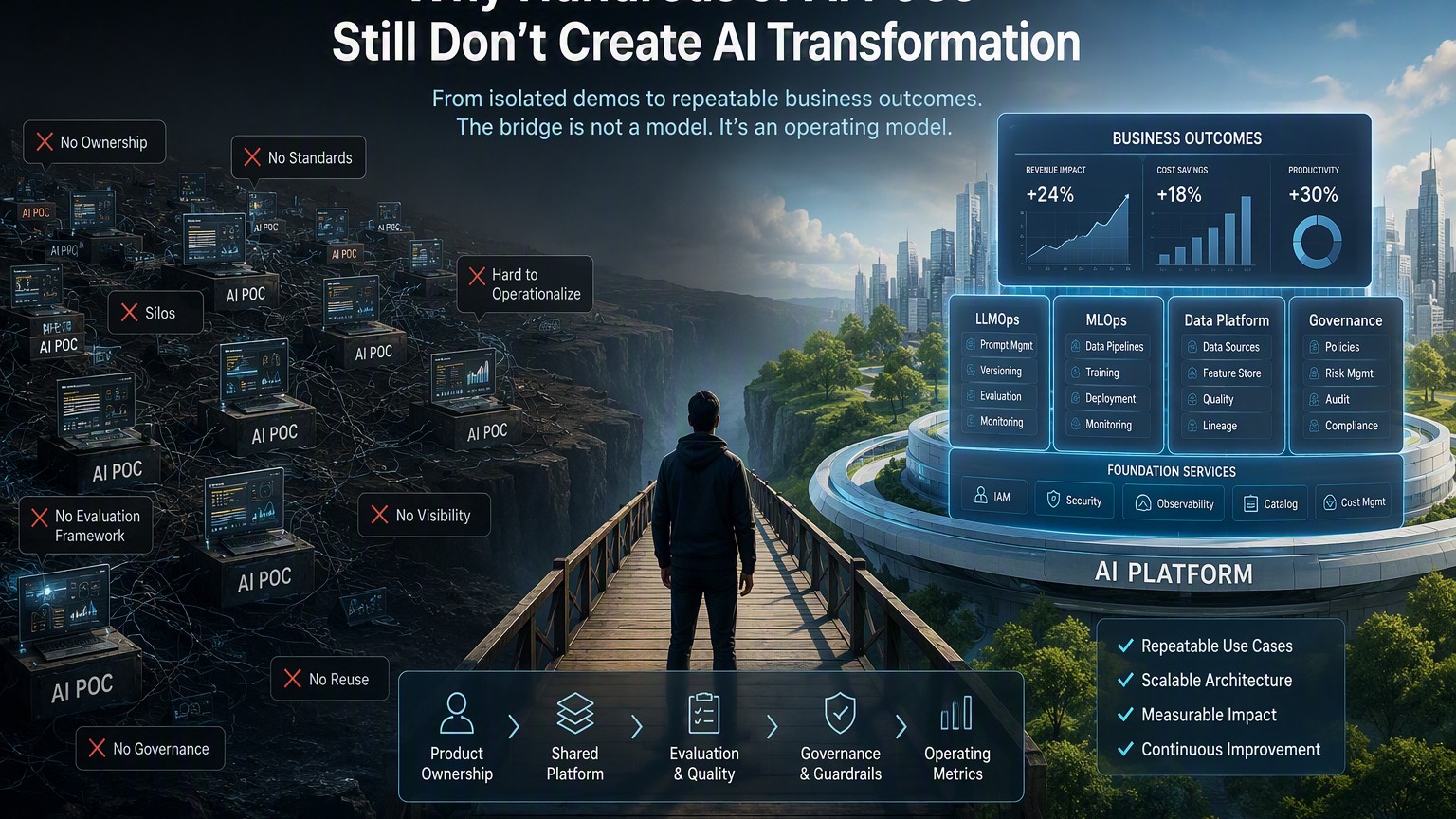
Deploying an AI assistant is not the same as becoming AI-native. A coding assistant may accelerate implementation, a support bot may draft responses, and a document model may extract fields. Yet the surrounding process often remains unchanged: the same handoffs, approval queues, team boundaries, and governance meetings continue to determine throughput.
The larger opportunity is to redesign the operating model around a new assumption: machines can perform parts of knowledge work, but humans remain accountable for objectives, constraints, exceptions, and outcomes.
That shift is architectural as much as organizational. It requires explicit decision rights, machine-readable policies, observable workflows, reusable platform capabilities, and feedback loops that improve both models and processes. The goal is not maximum automation. It is a system in which work moves faster without making responsibility ambiguous or risk invisible.
Why tool adoption reaches a ceiling
Most enterprises begin with individual productivity tools because they are easy to trial and do not require process changes. These tools can provide real value, but their impact is constrained by the workflow around them.
Consider an AI assistant that drafts a production change plan. If the result is copied into a ticket, reviewed in a weekly meeting, re-entered into a deployment system, and audited manually later, generation was accelerated but delivery was not transformed.
Tool-centric adoption commonly produces four problems:
- Local optimization: One task becomes faster while upstream and downstream queues remain unchanged.
- Shadow processes: Employees create prompts, spreadsheets, and unofficial automations outside governed systems.
- Unclear accountability: Teams cannot explain who owns an AI-assisted decision or when a human must intervene.
- Fragmented controls: Each application implements identity, logging, evaluation, and model access differently.
An AI-native operating model treats the entire value stream—not the prompt or model—as the unit of design.
What an AI-native operating model changes
An operating model defines how an organization turns strategy into repeatable execution. It covers process design, organizational structure, decision rights, technology, governance, funding, and measurement.
Making that model AI-native does not mean removing people. It means deliberately assigning work among people, deterministic software, and probabilistic models according to their strengths.
| Participant | Best suited to | Poorly suited to |
|---|---|---|
| Humans | Setting objectives, handling ambiguity, resolving novel exceptions, accepting accountability | Repetitive classification, high-volume comparison, continuous monitoring |
| Deterministic software | Validation, policy enforcement, calculations, transactions, access control | Interpreting incomplete context or generating open-ended plans |
| AI models | Summarization, extraction, recommendation, pattern recognition, drafting | Final accountability, guaranteed factuality, deterministic authorization |
This division matters. A model can recommend whether a software change appears risky, but deterministic policy should decide whether it qualifies for automatic deployment. A human should own the policy and review exceptional or high-impact cases.
Start with decisions, not use cases
Lists of AI use cases often describe activities such as “summarize tickets” or “generate reports.” They rarely identify which business decision changes as a result. Without that connection, teams optimize output volume rather than outcomes.
Map a value stream by asking:
- What outcome is the process intended to produce?
- Which decisions control flow through the process?
- What evidence does each decision require?
- Which rules are deterministic?
- Where is judgment genuinely necessary?
- What is the cost of a wrong decision?
- How can the outcome feed back into future decisions?
For a production change, the relevant decision is not “Can a model write a deployment summary?” It is “Under what conditions can this change proceed, and who accepts the residual risk?”
A redesigned flow might look like this:
flowchart LR
    A[Change submitted] --> B[Deterministic checks]
    B --> C[AI risk assessment]
    C --> D{Policy decision}
    D -->|Low risk| E[Automated deployment]
    D -->|Needs review| F[Human review]
    D -->|Blocked| G[Return with evidence]
    F --> E
    E --> H[Observe outcome]
    H --> I[Evaluation data]
    I --> C
The model contributes an assessment, but policy determines the route. Production telemetry then provides evidence about whether the assessment and policy were effective.
Define bounded autonomy
Automation should be graduated rather than binary. A useful autonomy ladder is:
- Assist: Generate content while a human performs the action.
- Recommend: Propose a decision with evidence; a human approves it.
- Act with confirmation: Prepare an action and request approval at execution time.
- Act within bounds: Execute automatically when explicit policy conditions are satisfied.
- Act and escalate exceptions: Handle routine cases while routing anomalies to people.
The appropriate level depends on impact, reversibility, confidence, evidence quality, and regulatory obligations. A low-value, reversible action may support bounded execution. An irreversible financial transaction should usually require stronger deterministic controls and human authorization.
Build workflows around explicit contracts
AI-native processes need more structure, not less. Free-form prompts are useful interfaces for exploration, but production workflows require typed inputs, constrained outputs, durable state, and clear failure semantics.
A model response should be treated as untrusted data. Validate its structure, verify relevant claims when possible, and separate its recommendation from the authorization to act.
The following simplified Python example illustrates that separation:
from dataclasses import dataclass
from enum import Enum

class Route(Enum):
    AUTO_DEPLOY = "auto_deploy"
    HUMAN_REVIEW = "human_review"
    BLOCK = "block"

@dataclass(frozen=True)
class ChangeEvidence:
    tests_passed: bool
    rollback_ready: bool
    touches_restricted_system: bool
    model_risk: str       # Validated before policy evaluation
    model_confidence: float


def route_change(e: ChangeEvidence) -> Route:
    if not e.tests_passed or not e.rollback_ready:
        return Route.BLOCK

    if e.touches_restricted_system:
        return Route.HUMAN_REVIEW

    if e.model_risk == "low" and e.model_confidence >= 0.90:
        return Route.AUTO_DEPLOY

    return Route.HUMAN_REVIEW
The model does not call the deployment system or grant itself permission. It supplies a bounded signal to deterministic policy. The confidence threshold is illustrative, not universally safe; it must be calibrated against evaluation data, and confidence values should not be assumed to represent real-world correctness without testing.
A production implementation would also validate allowed risk labels, authenticate the caller, record model and policy versions, make execution idempotent, and define behavior for timeouts or unavailable dependencies.
Design for abstention and fallback
Models will encounter incomplete, conflicting, or unfamiliar inputs. A workflow must provide a valid path for “unknown.” Forcing every request into a confident answer turns uncertainty into hidden risk.
Fallback design should specify:
- Conditions under which the model must abstain
- The queue or role that receives an exception
- The evidence presented to the reviewer
- Time limits and escalation rules
- Whether the process can continue in a degraded mode
- How the final resolution becomes evaluation data
Human review is not a generic safety feature. If every result is sent to an overloaded queue, reviewers will rubber-stamp recommendations. Review capacity, routing rules, and interface design are part of the system architecture.
Separate the execution, control, and evidence planes
Enterprises often build AI capabilities independently inside each application. That duplicates expensive and security-sensitive functions. A shared platform can provide common controls while domain teams retain ownership of their workflows.
A practical architecture has three logical planes:
- Execution plane: Workflow state, application services, tools, queues, and human tasks.
- Control plane: Identity, model routing, prompt and policy versions, permissions, secrets, budgets, and release controls.
- Evidence plane: Traces, evaluations, decisions, overrides, incidents, cost, and outcome metrics.
flowchart TB
    U[Users and systems] --> W[Domain workflows]
    W --> M[Model gateway]
    W --> T[Deterministic tools]
    W --> Q[Human task queue]

    C[Control plane] --> W
    C --> M
    C --> T

    W --> E[Evidence store]
    M --> E
    T --> E
    Q --> E
    E --> V[Evaluation and monitoring]
    V --> C
A model gateway can centralize provider access, authentication, quotas, and request metadata, but it should not become a monolith containing domain policy. Domain teams understand what constitutes an acceptable support refund, production change, or compliance exception. The platform team should provide primitives; domain owners should configure and operate the decision logic.
This separation also improves replaceability. Workflow contracts should depend on required capabilities and validated schemas rather than provider-specific response formats wherever practical.
Redesign teams and decision rights
Technology alone cannot repair an operating model organized around functional handoffs. If data scientists produce a model, application engineers integrate it, security reviews it at the end, and operations inherits it, no team owns the complete outcome.
For important AI-enabled value streams, create durable cross-functional ownership. A team may include:
- Domain and product leadership accountable for the outcome
- Software engineers responsible for workflow and integration reliability
- Data or ML engineers responsible for evaluation and model behavior
- Design specialists responsible for human review and exception handling
- Security, risk, or legal partners involved according to impact
- Operations representatives responsible for service performance
Not every role must be dedicated full time. What matters is that responsibilities are explicit and available throughout delivery, not only at approval gates.
A useful ownership boundary is the decision service: the workflow, evidence, policy, model behavior, and operational controls involved in making a class of decisions. Its owner should be accountable for both automation quality and business outcomes.
Make accountability explicit
For each consequential decision, document:
- Outcome owner: Accountable for the business result
- Policy owner: Defines the constraints under which automation may operate
- System owner: Maintains reliability, security, and observability
- Reviewer: Resolves exceptions and can override recommendations
- Audit owner: Confirms that required evidence is retained and controls work
The machine is never an accountable role. Phrases such as “the AI decided” conceal the policy, people, and systems that permitted an action.
Turn governance into a delivery capability
Governance frequently arrives as a questionnaire after implementation. That encourages teams to minimize disclosure, delays learning, and applies similar controls to very different risks.
Instead, encode governance into the delivery lifecycle:
- Classify the workflow by impact and data sensitivity.
- Attach required controls based on that classification.
- Run automated checks in development and deployment pipelines.
- Require additional review only where risk warrants it.
- Continuously monitor whether assumptions remain valid.
A low-impact internal summarizer does not require the same controls as a system influencing access, employment, credit, health, or safety. Risk tiers should affect evaluation depth, approval authority, audit retention, security testing, and permitted autonomy.
Governance artifacts should be generated from operational evidence where possible. Useful records include:
- Workflow, policy, prompt, and model versions
- Input and output classifications, with sensitive content appropriately protected
- Tool calls and authorization results
- Human approvals, edits, and overrides
- Evaluation results and release decisions
- Incidents, rollback events, and corrective actions
Logging everything is not inherently safe. Prompts and traces may contain personal data, credentials, or proprietary material. Apply data minimization, access controls, retention limits, and redaction to the evidence plane itself.
Measure the operating model, not model activity
Token volume, generated documents, and assistant adoption indicate usage, not value. Measurement should connect technical behavior to flow, quality, risk, and economics.
A balanced scorecard can include:
Flow
- End-to-end lead time
- Queue time between stages
- Percentage of routine cases completed without intervention
- Exception age and reviewer workload
Quality and risk
- Defect or rework rate
- Policy violation rate
- Unsupported-claim rate for relevant tasks
- Override rate and reasons
- Severity and reversibility of incorrect actions
Reliability and economics
- Workflow completion rate
- Model or tool failure rate
- Cost per successful outcome
- Latency by workflow stage
- Degraded-mode usage
Learning
- Time from incident to policy or evaluation update
- Coverage of known failure modes
- Performance by input segment
- Rate of repeated exceptions
Do not optimize a single metric in isolation. Increasing autonomous completion can reduce queue time while increasing costly errors. Lowering model cost can increase retries or reviewer effort. Measure the complete system.
A practical adoption sequence
Enterprises do not need a company-wide reorganization before beginning. They need one meaningful value stream and an explicit path from assistance to bounded autonomy.
1. Select a suitable workflow
Choose a process with measurable outcomes, sufficient volume, accessible evidence, and recoverable failures. Avoid starting with either a trivial demonstration or the organization’s highest-consequence decision.
2. Baseline the current system
Measure lead time, queue time, error rates, exception volume, operating cost, and control failures before adding AI. Otherwise, the team cannot distinguish improvement from novelty.
3. Map decisions and controls
Identify decision points, deterministic rules, judgment calls, data dependencies, and accountable owners. Remove unnecessary approvals before automating them.
4. Introduce recommendation mode
Run the model in shadow or recommendation mode. Compare its outputs with actual outcomes, collect reviewer reasons, and build an evaluation set from representative cases and known failures.
5. Add bounded execution
Permit automation only for a narrow, well-evaluated segment. Enforce permissions outside the model, provide rollback where possible, and define explicit stop conditions.
6. Productize shared capabilities
Once multiple workflows need the same primitives, invest in reusable identity, model access, evaluation, tracing, policy enforcement, and human-task integration. Standardize proven needs rather than predicting every future use case.
7. Revisit structure and funding
Fund enduring decision services and platform capabilities, not only short-lived pilots. Update role expectations, operational ownership, and review capacity as automation changes where work occurs.
Common failure modes
Several patterns repeatedly prevent the operating model from changing:
- Automating a broken process: Existing approvals and handoffs are reproduced with a model inserted between them.
- Giving the model excessive authority: Recommendation and authorization are combined in one opaque step.
- Treating human review as unlimited: Exception queues grow without staffing, prioritization, or service objectives.
- Centralizing all domain decisions: A platform team becomes a bottleneck and encodes policies it does not own.
- Skipping evaluation design: Teams test impressive examples but do not measure representative or adversarial cases.
- Ignoring reversibility: Automation expands without rollback, compensation, or containment mechanisms.
- Measuring adoption instead of outcomes: High usage masks unchanged lead time or increased rework.
The corrective principle is consistent: design the socio-technical system around outcomes, evidence, and accountability—not around access to a model.
Conclusion
Moving from AI tools to an AI-native operating model requires more than deploying assistants. Enterprises must redesign value streams, expose decision points, assign bounded autonomy, encode policy, build evidence into execution, and give durable teams ownership of complete outcomes.
The most effective architecture does not ask a model to be a database, policy engine, authorization service, and accountable decision-maker. It combines probabilistic capabilities with deterministic controls and informed human judgment.
Start with one consequential but recoverable workflow. Measure its current performance, redesign its decisions, automate only within explicit bounds, and use operational evidence to expand safely. Repeated across value streams, that discipline turns isolated AI features into a coherent way of operating.