Knowledge library
Articles
Engineering decisions, implementation notes, and operational field guides.
9 entries

From AI Tools to AI-Native Operating Models
A practical guide to redesigning enterprise workflows, teams, decision rights, governance, and technical platforms around accountable human and machine collaboration.

The AI Productivity Paradox: What Happens to the Time We Save?
AI can make individual tasks faster without improving organizational performance. Learn where saved time actually goes, why higher workloads can suppress adoption, and how leaders can turn productivity gains into faster flow, better quality, resilience, and innovation.

API Versioning Without Creating v1, v2, v3 Chaos
A practical enterprise strategy for evolving APIs through compatibility rules, automated change detection, visible deprecations, measured migration windows, and lifecycle governance.

AI Governance Should Be a Guardrail, Not a Gate
Strong AI governance does not require routing every experiment through a review board. Learn how risk tiers, automated controls, approved safe paths, and targeted human review can protect an enterprise without stopping delivery.

How to Build an Enterprise API Governance Model That Developers Don’t Hate
A practical API governance model built on paved roads, automated contract checks, risk-based reviews, and time-bound exceptions—without turning every API change into a committee meeting.
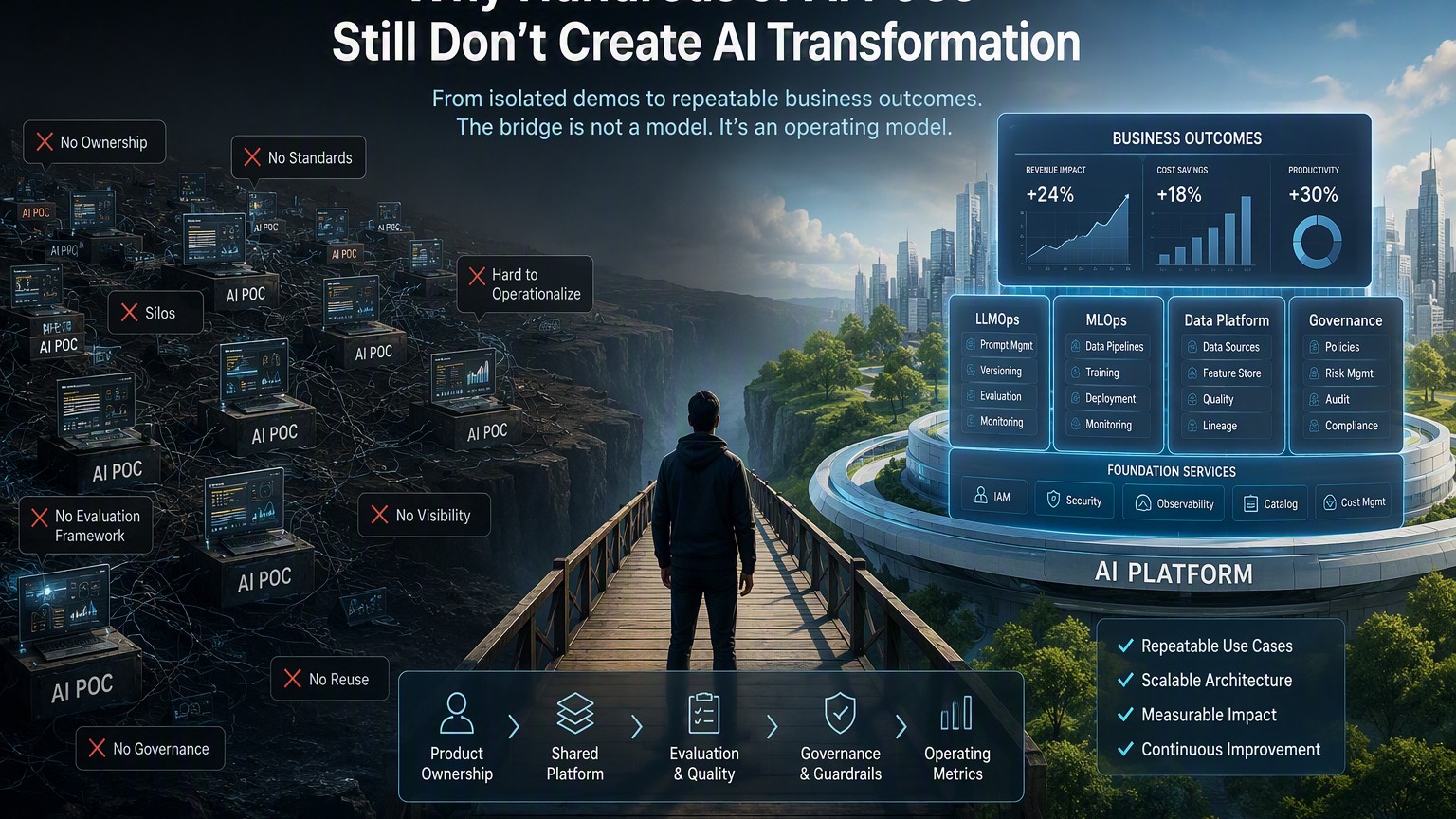
Why Hundreds of AI PoCs Still Don't Create AI Transformation
AI proofs of concept are easy to start and difficult to operationalize. Learn why experimentation rarely compounds into enterprise transformation—and how product ownership, shared platforms, evaluation, governance, and operating metrics turn isolated demos into repeatable business outcomes.

Why Prompt Engineering Is Not an Enterprise AI Skill Strategy
Prompt techniques can improve individual outputs, but enterprise AI adoption depends on verification, workflow redesign, critical thinking, risk controls, and domain judgment. Here is a practical capability model for engineering leaders.

Why Your Microservices Architecture Became a Distributed Monolith
Excessive synchronous service calls can make independently deployed microservices fail and scale as one system. Learn how to identify runtime coupling, contain cascading failures, and incrementally introduce events, local read models, bulkheads, and sagas.

Why AI Is Harder to Implement in Japan—and Why Technology Is Rarely the Problem
Japan has the engineering talent and infrastructure to lead in enterprise AI. The harder challenge is organizational: shortening the path from experiment to production while managing risk, imperfect data, approvals, and continuous learning.